The Geology of the Band
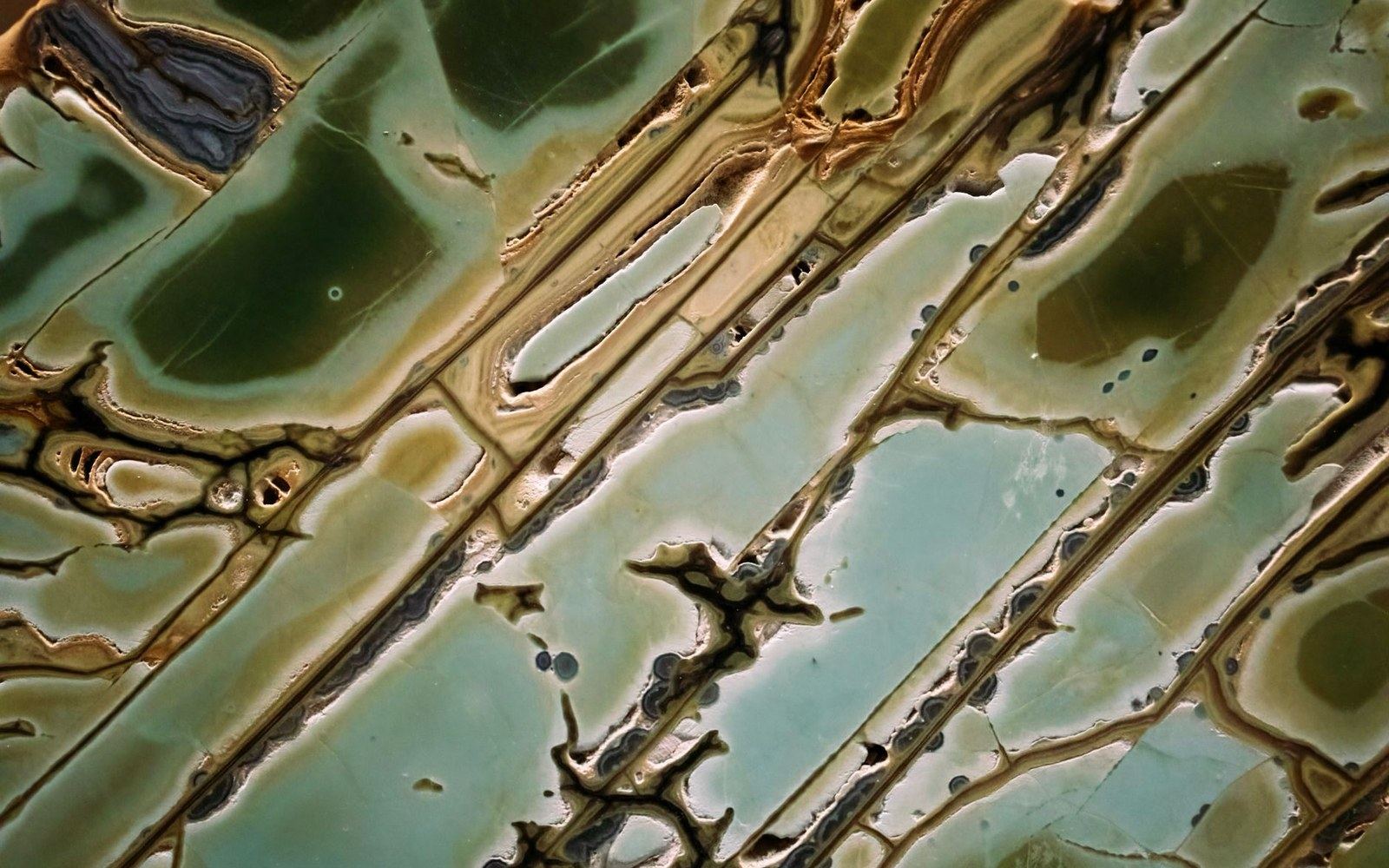
Agate is a banded variety of chalcedony — microcrystalline quartz with individual crystals too small to resolve without a microscope. Its defining feature is concentric layering: bands that trace the inner wall of a host cavity and work inward, sometimes filling the void entirely, sometimes leaving a hollow core lined with macrocrystalline quartz crystals.
The cavities themselves are volcanic vesicles, gas bubbles frozen into basalt or rhyolite as lava cooled. Long after the host rock solidified, silica-saturated groundwater percolated through fractures and entered these pores. The prevailing model, supported by geochemical studies of banding periodicity, holds that silica precipitated from hydrothermal solution as successive thin films of gel, each subsequently dehydrating and crystallising into chalcedony. Trace elements and colloidal impurities — iron oxides for reds and yellows, manganese for blacks, chlorite for greens — were incorporated into individual layers at different concentrations, producing colour contrast between bands. The process is slow: isotopic dating of agate-bearing volcanics and the thickness of individual bands both point to formation timescales measured in thousands to tens of thousands of years.
Also in Quartz: Purple Quartz, and Why Heat Turns It Yellow
Photo: Alex Szarka / Pexels
What makes each agate individual is the sequence of solutions that reached the cavity. A change in groundwater chemistry, a shift in temperature, a fresh influx of iron-bearing fluid — each event is recorded as a new band. The mineral composition and banding structure have been characterised in detail by researchers working with Raman spectroscopy and electron microprobe analysis, confirming that individual layers may vary in cristobalite content, porosity, and trace-element signature even where visible colour difference is subtle.
Idar-Oberstein and the Cutting Tradition
The Nahe valley in what is now Rhineland-Palatinate, Germany, harbours one of the world's most thoroughly documented gem-working histories. Agate occurs in the Permian volcanic sequence exposed along the river Idar; the nodules weather out of the host basalt and collect in valley gravels. Written records of agate cutting at Idar-Oberstein reach back to the fifteenth century, making it the oldest continuously documented lapidary centre in central Europe. Water-powered grinding wheels on the Idar river drove large sandstone discs against which cutters worked prone, pressing agate slabs by hand — a posture that characterised the trade for centuries and left its mark on the occupational health of workers across generations.
By the early nineteenth century, the local Brazilian connection transformed the industry. Emigrants from Idar-Oberstein who had established themselves in Rio Grande do Sul sent back rough agate from the basalt sequences of Rio Grande do Sul and the neighbouring southern Brazilian states, where vesicular volcanic rocks yield nodules far larger than the depleted German deposits. The Brazilian supply kept Idar-Oberstein's workshops running and enabled the town to expand from simple banding display into intricate carving, cameo cutting and the production of precision instrument components from agate's uniform hardness (7 on the Mohs scale).
Artificial dyeing of agate was also systematised at Idar-Oberstein. Because chalcedony is porous at the microscale, stones can be soaked in iron-salt solutions and then heated to deposit iron oxide within the microcrystalline structure, producing the saturated reds and uniform blacks that rarely occur naturally with such consistency. The practice was understood locally by at least the early nineteenth century and is now disclosed as standard trade practice under GIA grading conventions.
Today the town hosts the Deutsche Edelsteinstraße (German Gemstone Road) heritage route and the Deutsches Edelsteinmuseum, which holds reference collections of rough, cut and carved material from regional and international sources. The tradition Georg Agricola documented in the broader Rhineland mining context in his 1556 De Re Metallica had already been practised at Idar-Oberstein for a century before his text appeared. That continuity — from medieval water wheels to modern spectroscopic sorting — is itself a kind of stratigraphy, each technological layer deposited on the one before it, much like the bands in the stones the valley made famous.
Related