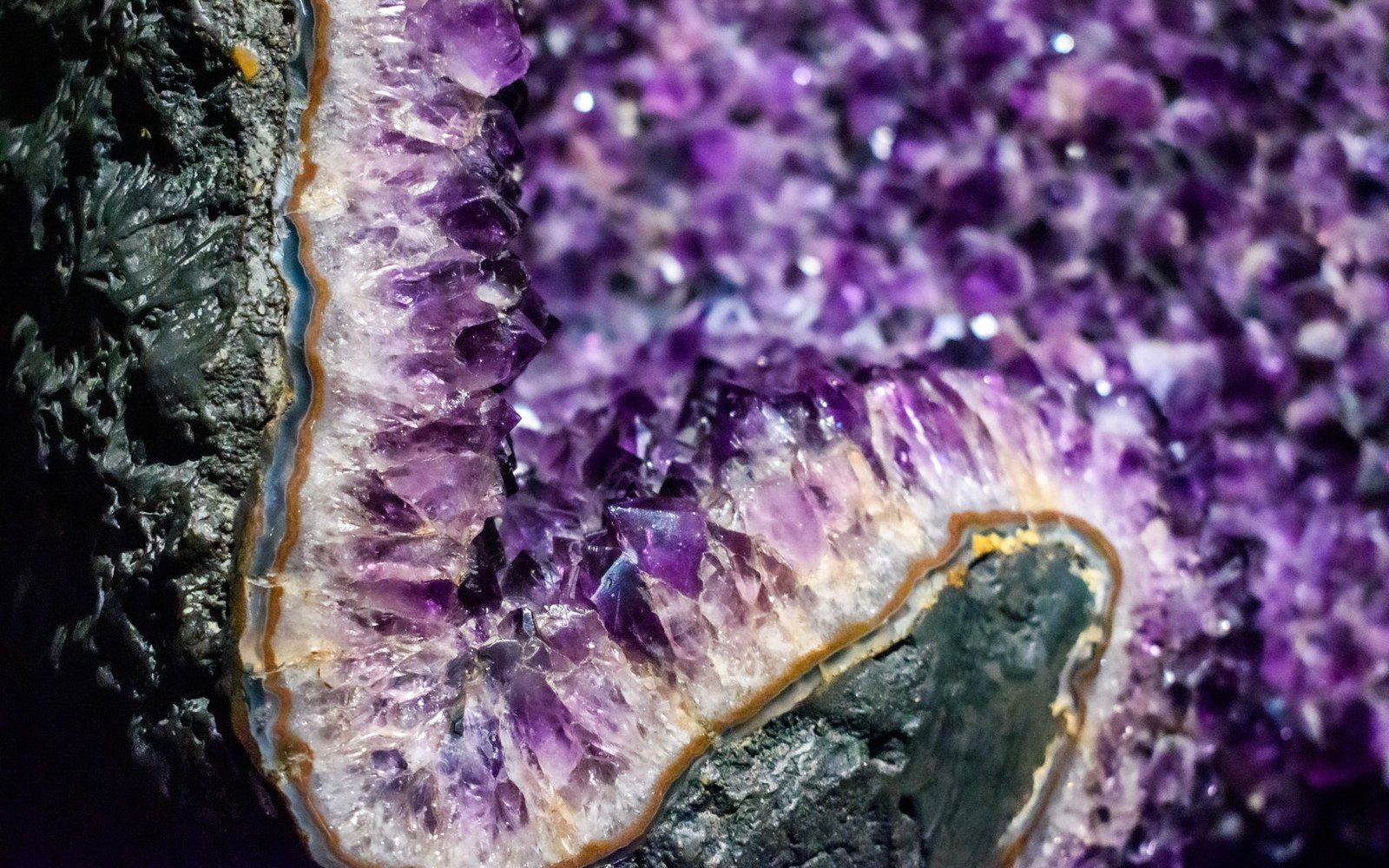
The Iron Impurity That Makes Quartz Purple
Pure quartz — silicon dioxide, SiO₂ — is colourless. Amethyst owes its purple to trace iron (Fe⁴⁺) incorporated into the crystal lattice during growth, combined with colour centres: lattice defects generated by natural gamma irradiation from surrounding radioactive minerals. Those defects absorb wavelengths in the yellow range, leaving the transmitted light violet to deep purple. The depth of colour depends on both iron concentration and irradiation dose, which is why a single Brazilian crystal can grade from pale lilac at its tip to saturated violet at its base.
The most significant amethyst deposits sit in geodes hosted in volcanic basalt. Brazil, chiefly Rio Grande do Sul state, supplies the bulk of world production; Uruguay's Artigas department produces a darker, more saturated material from comparatively thin-walled geodes. Both sources draw material from amygdaloidal cavities in Paraná flood basalt, where silica-rich hydrothermal fluids deposited quartz crystals over millions of years. The Ural Mountains around Yekaterinburg historically yielded fine specimens now held in European natural-history collections, though commercial output from that region is negligible today.
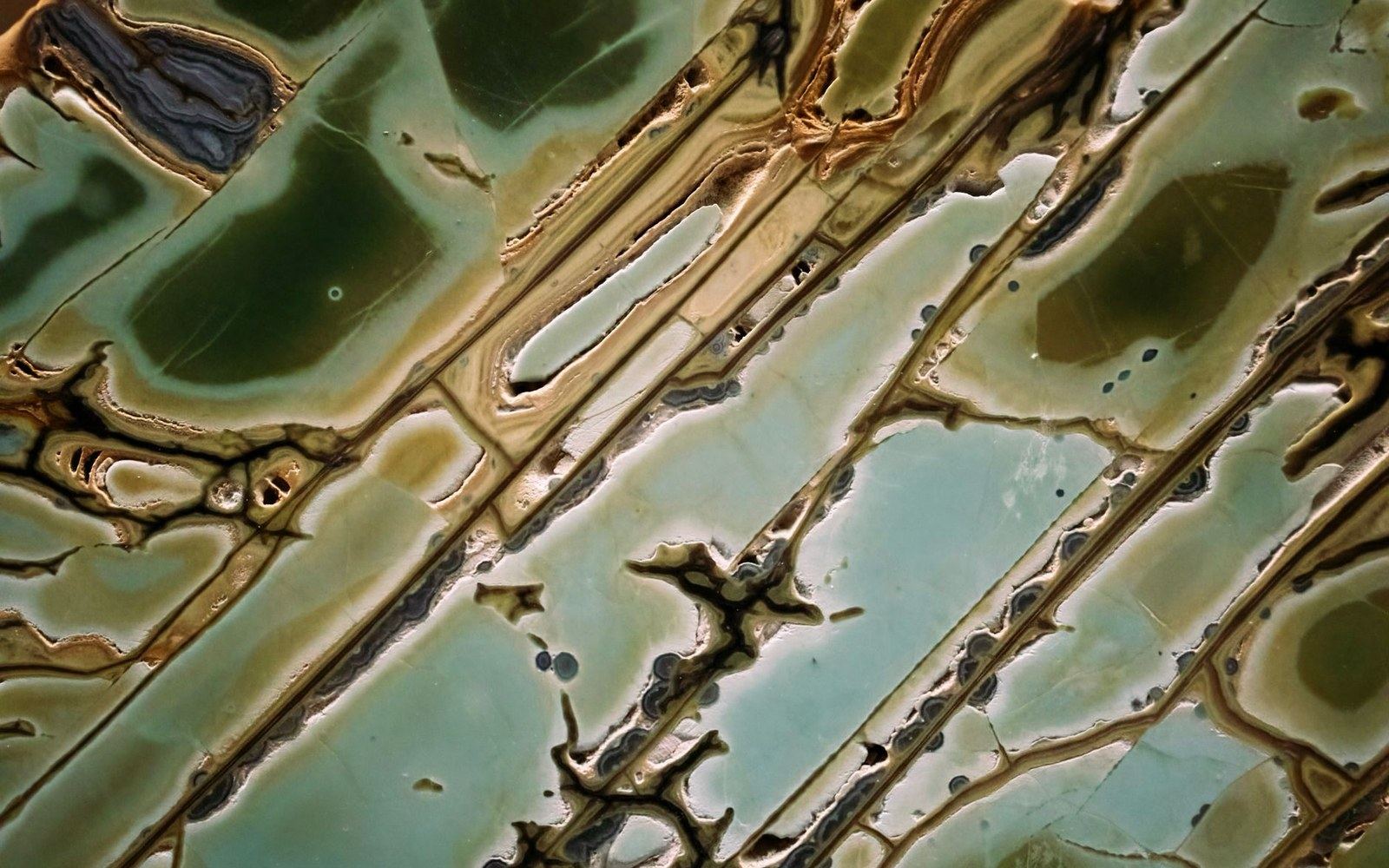
Also in Quartz: Agate Bands Form Over Thousands of Years in a Cavity
Photo: James Lee / Pexels
What 400°C Does to the Lattice
Heat the same amethyst crystal to roughly 400–500°C and the colour centres destabilise. The iron shifts oxidation state — from Fe⁴⁺ toward Fe³⁺ — and the defect configuration that absorbed yellow light collapses into one that absorbs blue-violet instead, transmitting yellow to orange. The result is citrine. The transformation is irreversible under ordinary conditions: no practical process reconverts heat-treated citrine to amethyst. Because natural citrine — formed by geothermal heat acting on iron-bearing quartz in situ — is genuinely rare, the Gemological Institute of America notes that the large majority of commercial citrine is heat-treated amethyst, a fact that responsible disclosure requires sellers to state.
Hardness and Fracture
Quartz sits at 7 on Friedrich Mohs's 1812 hardness scale, hard enough to scratch glass and resist everyday abrasion, which makes both amethyst and citrine durable in set jewellery. The mineral cleaves poorly and instead exhibits conchoidal fracture — smooth, curved breakage surfaces like chipped glass — a property Georg Agricola documented in sixteenth-century mineralogical writing and one that cutters in Idar-Oberstein learned to manage across centuries of working European agate and quartz material.
Related