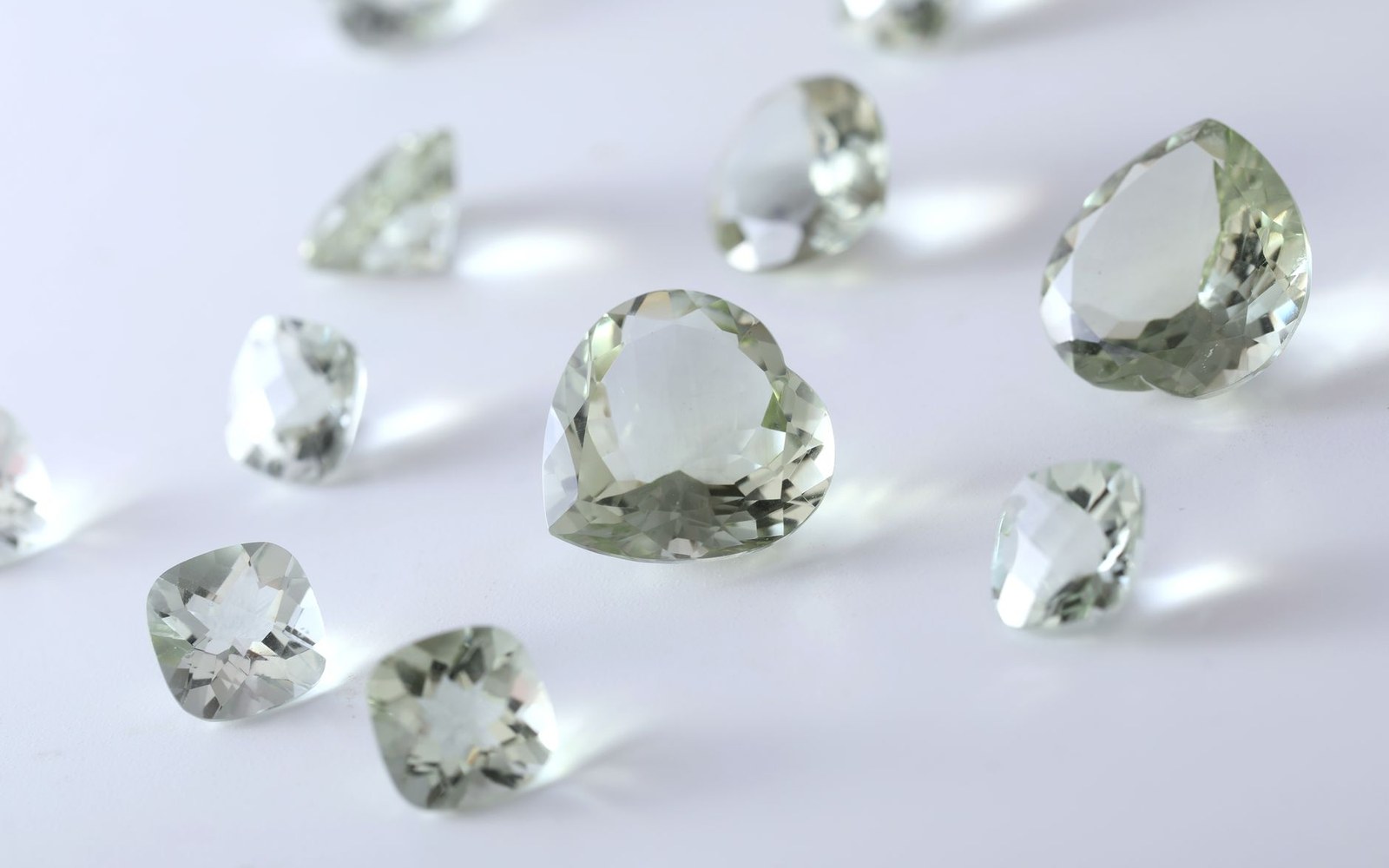
Iron and Manganese Do the Colouring
Beryl is beryllium aluminium cyclosilicate (Be₃Al₂Si₆O₁₈), and its colour in any given crystal depends entirely on which trace elements substitute into its lattice. Emerald gets chromium, occasionally vanadium. The other two principal gem varieties are coloured by simpler chemistry: aquamarine by ferrous iron (Fe²⁺), which absorbs in the yellow-red range to produce tones from pale sky-blue to deep blue-green; morganite by manganese, which pushes the stone into pink and peach territory.
The GIA classifies aquamarine and morganite both as Type I in its clarity grading framework — stones typically expected to be eye-clean. Neither receives the "Type III" dispensation extended to emerald, whose jardin is treated as intrinsic to the variety.
Also in Beryl: Emerald Is the One Gemstone the Trade Agreed to Forgive
Photo: turek / Pexels
Aquamarine's principal documented source is the state of Minas Gerais in Brazil, where pegmatite pockets have yielded crystals of exceptional size and transparency. The Marambaia and Golconda districts within Minas Gerais have produced crystals running to tens of kilograms; the Dom Pedro aquamarine, now in the Smithsonian's National Museum of Natural History, is a faceted obelisk of 10,363 carats cut by German lapidary Bernd Munsteiner from a single Minas Gerais crystal. Secondary sources include the Karakorum pegmatites of Pakistan and alluvial deposits in Madagascar, though Minas Gerais material sets the benchmark against which colour is commercially assessed.
Morganite was first described formally in 1910 from material collected on the Malagasy island — Madagascar — and was named by George Frederick Kunz, then chief gemologist at Tiffany & Co., in honour of banker and mineral collector J.P. Morgan. The original locality is the Antsirabe region. A significant secondary source opened at Pala, San Diego County, California, where pegmatite workings in the early twentieth century produced the pink beryl specimens that filled American museum cases; Pala material sits in the collections of the Natural History Museum of Los Angeles County and elsewhere. Afghanistan's Nuristan province has more recently yielded morganite of notable saturation, though production is irregular.
Hardness for both varieties is 7.5 to 8 on the Mohs scale, identical to all beryl, and refractive index runs from approximately 1.577 to 1.583 — diagnostically lower than corundum, higher than quartz. Both are commonly heat-treated: aquamarine to reduce green tones toward pure blue, morganite to deepen or even out its pink. GIA reports document treatment disclosure for both when applicable.
Related