The Rock Before the Mine
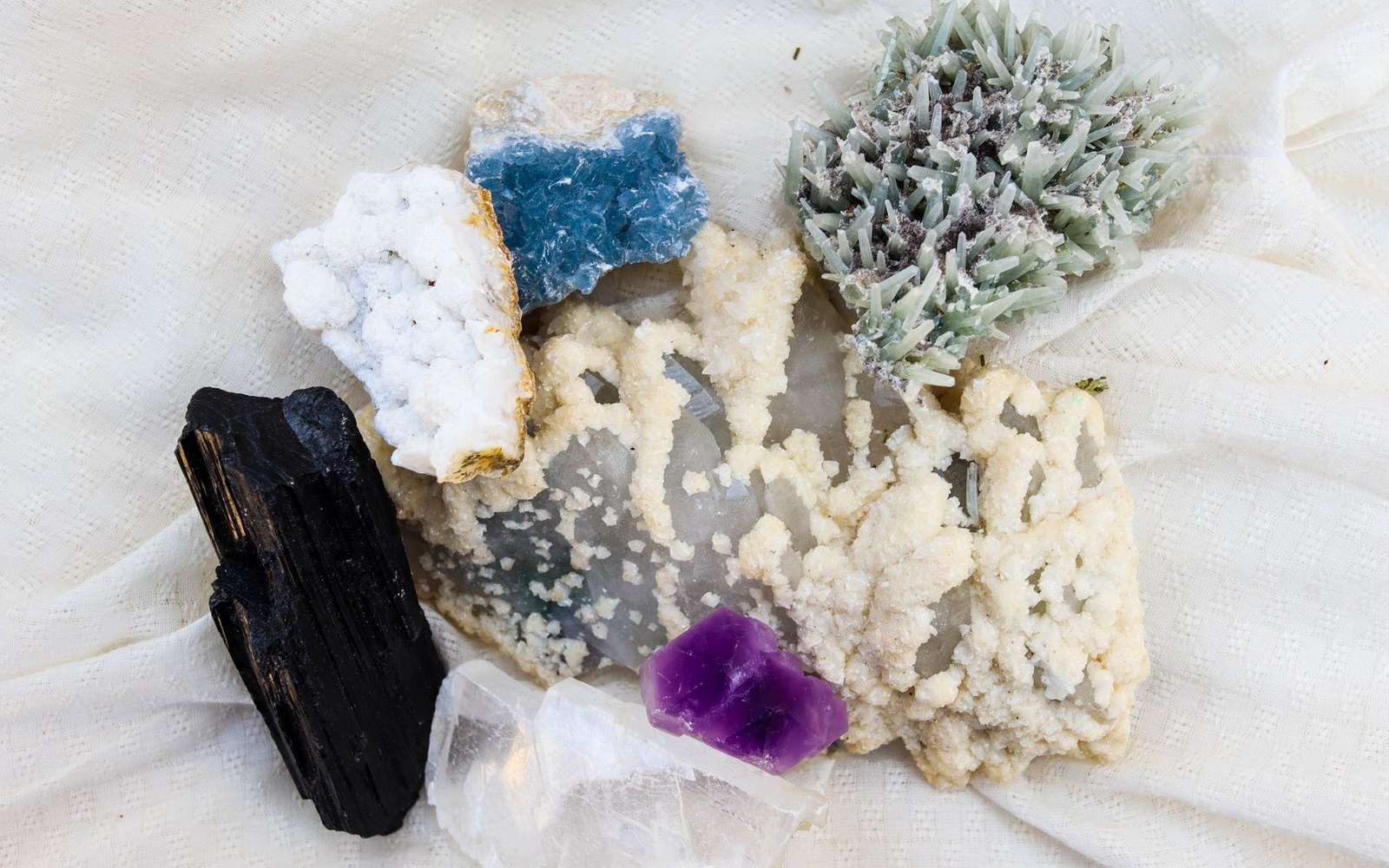
The emeralds of Boyacá do not come from marble, schist or granite pegmatite. They crystallise from a peculiar black carbonaceous shale — a sedimentary sequence of Cretaceous age that was fractured by tectonic activity and then infiltrated by warm, saline hydrothermal fluids rich in beryllium, chromium and vanadium. Where those fluids cooled inside the fractures, emerald-bearing calcite-albite veins precipitated. The colour is a product of that specific chemistry: chromium and vanadium substituting for aluminium in the beryl lattice produce the saturated green for which Colombian stones remain the trade's reference standard.
Muzo, in northwestern Boyacá, and Chivor, roughly 140 kilometres to the east-northeast in the same department, are the two named districts. They sit within the Eastern Cordillera of the Colombian Andes on structurally similar but separately formed vein systems. Both were productive before any European administrator recorded them.

Also in Beryl: Emerald Is the One Gemstone the Trade Agreed to Forgive
Photo: turek / Pexels
Muisca Extraction and the Spanish Seizure
The Muisca — the indigenous confederation whose territory covered much of highland Colombia's Eastern Cordillera — were mining and trading emeralds well before the Spanish arrived in the 1530s. Archaeological and chronicle evidence documents Muisca emerald use in ritual contexts: stones were offered at the lake of Guatavita and used in exchange networks that reached coastal trade routes. Spanish chroniclers, including Pedro de Cieza de León in his mid-sixteenth-century writings on the conquest of Peru and New Granada, described emerald mines already in active production when Spanish forces reached the region.
At Muzo, where the workings centred on Itoco, sustained resistance — the Muzos, a distinct group from the surrounding Muisca — delayed permanent Spanish control until 1559, when the settlement of Muzo was formally established and the mines placed under Crown administration. Chivor's pre-Columbian identity in Spanish records is somewhat less precisely dated, and the district was largely abandoned and its location lost to European knowledge for portions of the colonial period, only to be rediscovered by the Colombian mining engineer Francisco Restrepo late in the nineteenth century.
Once under Spanish control, Muzo was worked through a colonial mita (rotating forced-labour draft) system — the same institutional mechanism applied to silver extraction at Potosí. Output fed both the Iberian gem trade and the broader European market that was, for the first time, handling large quantities of fine emeralds. Before Colombian material arrived, green stones of quality were scarce enough that European lapidaries often substituted green glass; after Muzo and Chivor, emerald became a distinct and commonly traded commodity.
The Geology in Detail
Muzo's vein system is hosted in the Muzo Formation, a black, organic-rich shale of Hauterivian age — early Cretaceous, roughly 130–125 million years old. The emerald-bearing veins cut through this shale as networks of white-to-grey calcite and albite, with emerald crystals growing in open vugs (cavities) within the vein. The association with pyrite, parisite and other fluorocarbonate minerals is characteristic. Importantly, the fluid that deposited these crystals was not magmatic but evaporitic-brine-derived: geochemical studies published in peer-reviewed mineralogical literature indicate the beryllium was likely mobilised from granitic basement rocks far below, while chromium came from mafic horizons in the sedimentary column itself. The result is an emerald with a jardin — a population of three-phase fluid inclusions containing liquid, vapour and a solid halite crystal — that is diagnostic of Colombian origin.
Chivor's geology is geologically parallel in mechanism but not in age or exact formation. Its host shale is the Chivor Formation, of slightly different stratigraphic position, and its emeralds carry a different inclusion fingerprint: they contain parisite and relatively less pyrite, and the jardin of a Chivor stone tends toward iron-stained fractures and growth tubes rather than the three-phase brine inclusions common at Muzo. The Gemological Institute of America has published origin-determination research distinguishing Muzo-type from Chivor-type Colombian material, a separation that matters to the auction market because the trade associates Muzo with warmer, slightly more yellowish greens and Chivor with cooler, purer hues — though the overlap is substantial enough that laboratory instruments, not eyes, make the call.
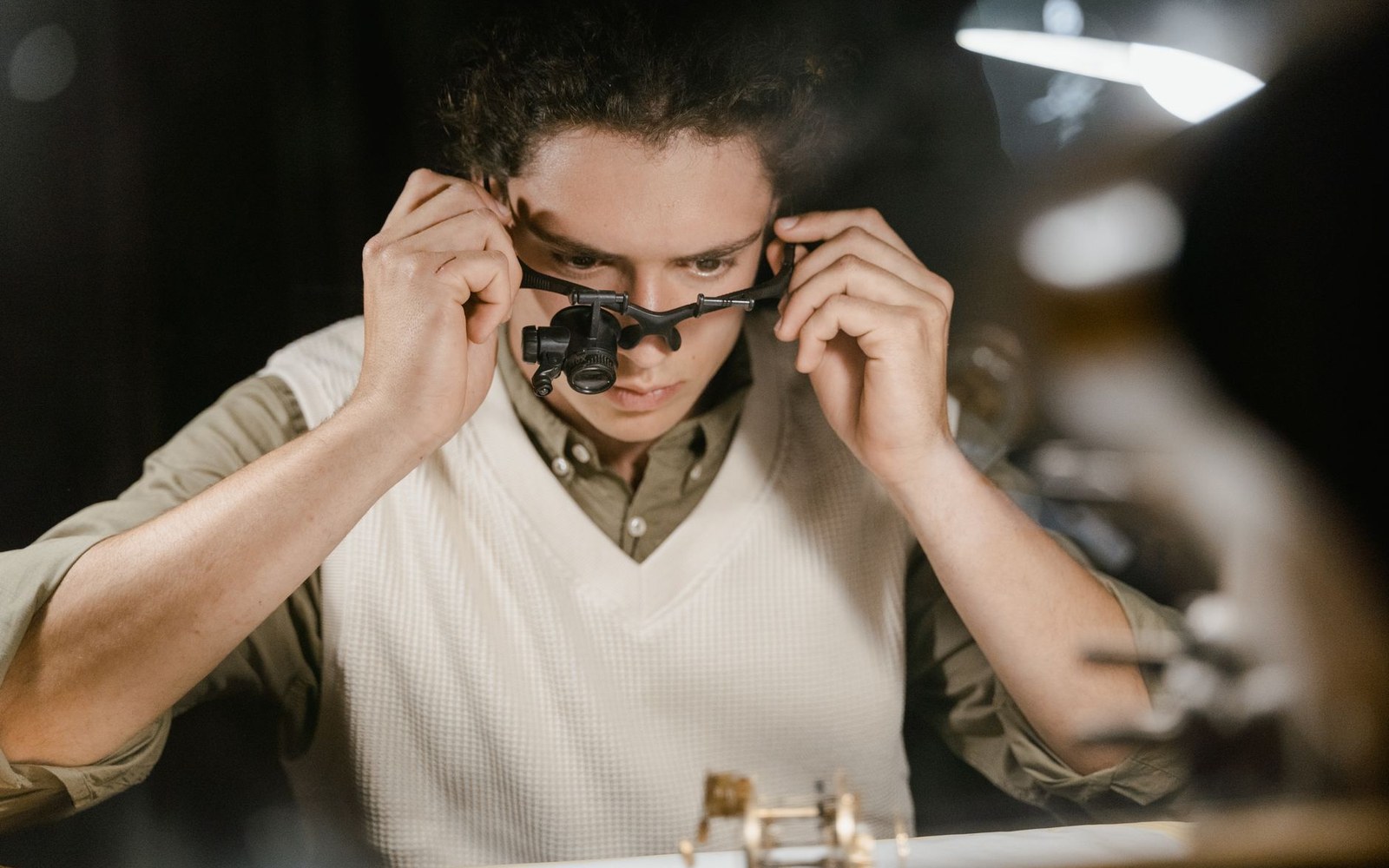
Ten-power magnification is the standard the trade grades emerald clarity at, and the jardin is expected to be visible in it.
Photo: Tima Miroshnichenko / Pexels
From Crown to Concession
After Colombian independence in 1819, the mines passed from Spanish Crown ownership to the Republic of Colombia. Throughout the nineteenth century Muzo was intermittently worked under state and private arrangements, productivity varying sharply. Chivor's colonial-era output had dwindled and the district's location had effectively dropped from active knowledge, which is why Restrepo's rediscovery was treated as a genuine find rather than a resumption — he traced colonial Spanish texts to locate the vein outcrops.
The twentieth century brought concession agreements: private companies holding extraction rights from the Colombian state under royalty obligations. These arrangements were periodically renegotiated and in the mid-twentieth century the mines at Muzo passed through several corporate hands before extended concession control became associated with private Colombian operators. The Chivor concession, notably, was held by an American-incorporated company — Chivor Emerald Mines — for a period of the early twentieth century, during which systematic modern extraction was established and stones from the district began appearing in European and American auction houses with documented Chivor provenance.
The security history of both mines is inseparable from Colombian civil unrest during the latter decades of the twentieth century, particularly the period of the so-called guerra verde (green war), when competing interests fought violently over production territory. The Colombian government's mining authority, the Agencia Nacional de Minería, now administers concession contracts, environmental compliance and royalty collection — a statutory framework that replaced earlier ad hoc arrangements and brought a degree of institutional accountability to extraction that the colonial mita never attempted.
What the Stones Carry With Them
A Muzo or Chivor emerald arriving at a grading laboratory today carries, in its inclusions, a record of those Cretaceous hydrothermal fluids, of the specific shale chemistry of one Colombian valley rather than another, and — if it carries documentation — a provenance trail that may reach back through a concession operator, a Bogotá dealer and a customs export certificate. The stone does not carry documentation of its pre-Columbian extraction, but the mine site does: archaeological excavation at Muzo has identified pre-Hispanic mining tools and extraction features in the shale, establishing that the vein systems were understood and exploited centuries before European mineralogy gave them a systematic name.
Colombian law requires export certification for rough and cut emeralds, and the country remains, by volume of high-quality material, the dominant source of gem emerald globally. The indigenous miners who worked the black shale at Itoco did not have a Mohs scale or a refractive index, but they had, demonstrably, the same rock — and they had found the veins first.
Related