A Language for Light and Weight
Before 1953, a diamond dealer's description of a stone was a private vocabulary. "Fine white," "blue-white," "commercial quality" — the terms meant different things in Antwerp, New York and Amsterdam, and a buyer could not know whether a seller's "flawless" matched his own. What the Gemological Institute of America codified that year was not a grading method so much as a shared grammar: four measurable criteria, each assigned a bounded scale, together producing a description that meant the same thing wherever it was read.
The GIA had been moving toward this for two decades. Robert Shipley founded the Institute in 1931 with the explicit aim of professionalising the American gem trade through education and consistent terminology. Early GIA courses already taught graders to evaluate colour and clarity, but the evaluations were not yet tied to a standardised written grade that a certificate could carry. The discipline existed; the published language did not.

Also in Diamond: What the Kimberley Process Actually Certifies
Photo: The Minister of State for Commerce and Power, Shri Jairam Ramesh addressing the Plenary Meeting of the Kimberley Process Certification Scheme (KPCS), in New Delhi on November 03, 2008 · Wikimedia Commons
What Each Letter Measures
The four Cs — cut, colour, clarity and carat weight — address different physical realities, and the GIA was deliberate about treating them separately rather than collapsing them into a single quality score.
Colour in a white diamond is the absence of it. The GIA colour scale runs from D, colourless, to Z, noticeably yellow or brown, with each letter representing a narrow band of body colour assessed by a trained grader comparing the stone against a set of masterstones under controlled lighting. D was chosen as the starting point precisely because the trade already had stones it called A, B and C — starting fresh at D cleared the field. Beyond Z, the scale gives way to the separate category of fancy colour, where saturation and hue are desirable rather than penalised.
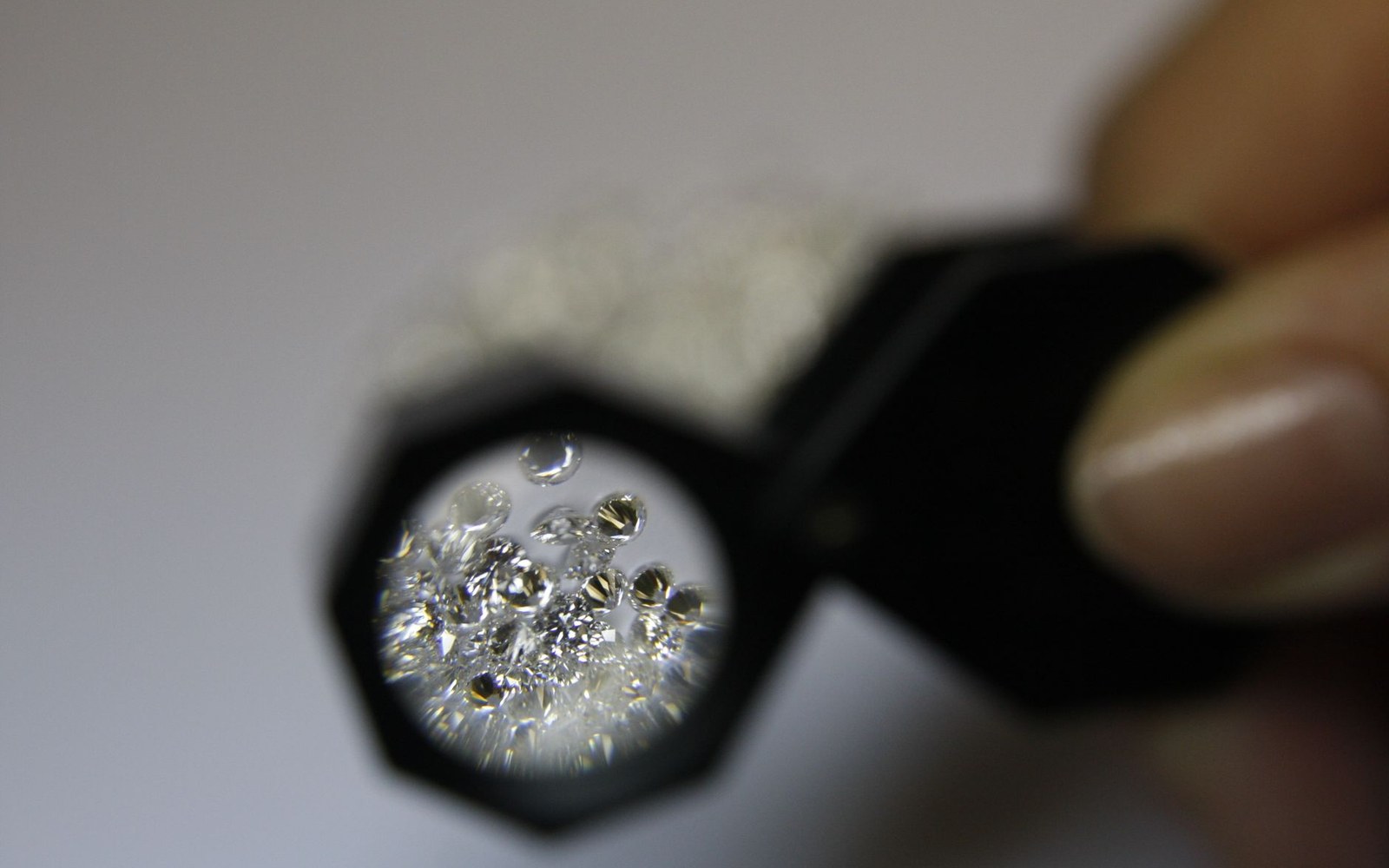
Clarity grades the presence, nature, size and position of internal features (inclusions) and surface characteristics (blemishes). The scale runs from Flawless through Internally Flawless, then VVS1 and VVS2 (very, very slightly included), VS1 and VS2, SI1 and SI2, and finally I1, I2 and I3 — inclusions visible to the naked eye. Grades are assigned under ten-times magnification, a convention the GIA standardised; at higher magnifications, virtually no stone is clean.
Carat weight is the only criterion that is a direct measurement rather than a judgment. One metric carat equals 0.2 grams, a definition the international gem trade had already converged on in 1907, but which still needed embedding in a grading framework that connected weight to the other three criteria. Carat weight does not determine value alone — a poorly cut, heavily included one-carat stone is worth less than a well-cut, clean half-carat — and the four Cs only make sense read together.
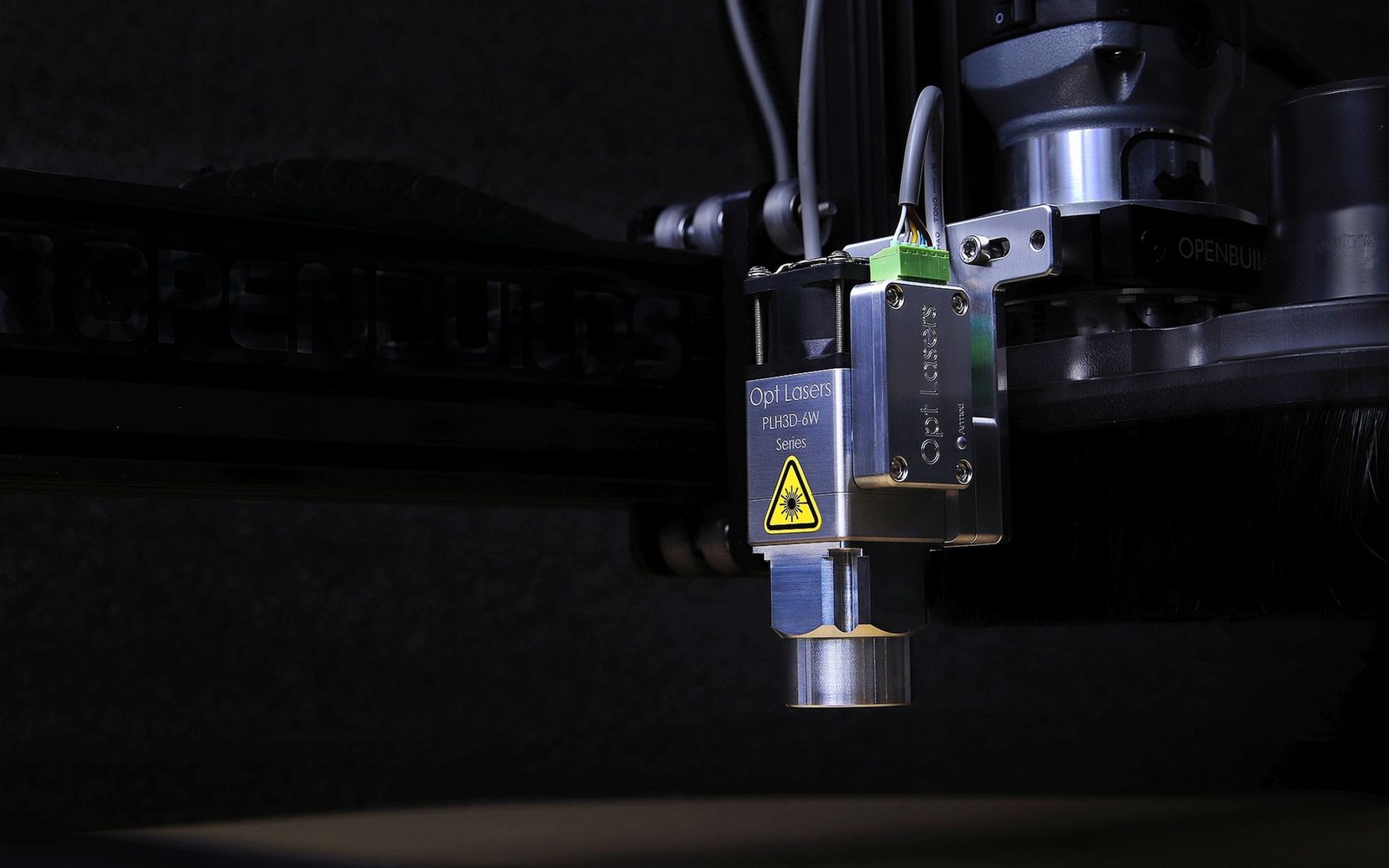
The dop arm holds the stone at a fixed angle and the lap does the work; Tolkowsky's proportions are angles set on this machine.
Photo: Opt Lasers from Poland / Pexels
Cut is the most complex of the four because it is the only criterion that is entirely human-made. The GIA's cut grade, a much later addition to the system that applies only to round brilliant diamonds, evaluates proportions, symmetry and polish — the variables that determine how light enters, reflects and exits a stone. Marcel Tolkowsky's 1919 mathematical analysis of the ideal round brilliant had established the theoretical underpinning, but the GIA's grading framework turned a mathematical ideal into a practical, reproducible assessment.
Why It Spread
The four Cs became standard not because the GIA required it but because the market selected for it. A GIA grading report gave a buyer in one city a reliable description of a stone held by a seller in another, which is the precondition for a functioning traded market. By the 1960s, major dealers and auction houses were routinely commissioning GIA reports; by the 1980s, the presence of a report had become close to expected on stones above a threshold size.
Other laboratories — the International Gemological Institute, the Antwerp-based HRD — developed their own grading systems, but all of them use the same four criteria in the same sequence, which is itself evidence of how completely the GIA's framework had defined the category. The letters vary only slightly; the underlying logic is the same. Shipley's ambition was a professional language the trade could share across borders. The four Cs, fixed in 1953, became precisely that.
Related