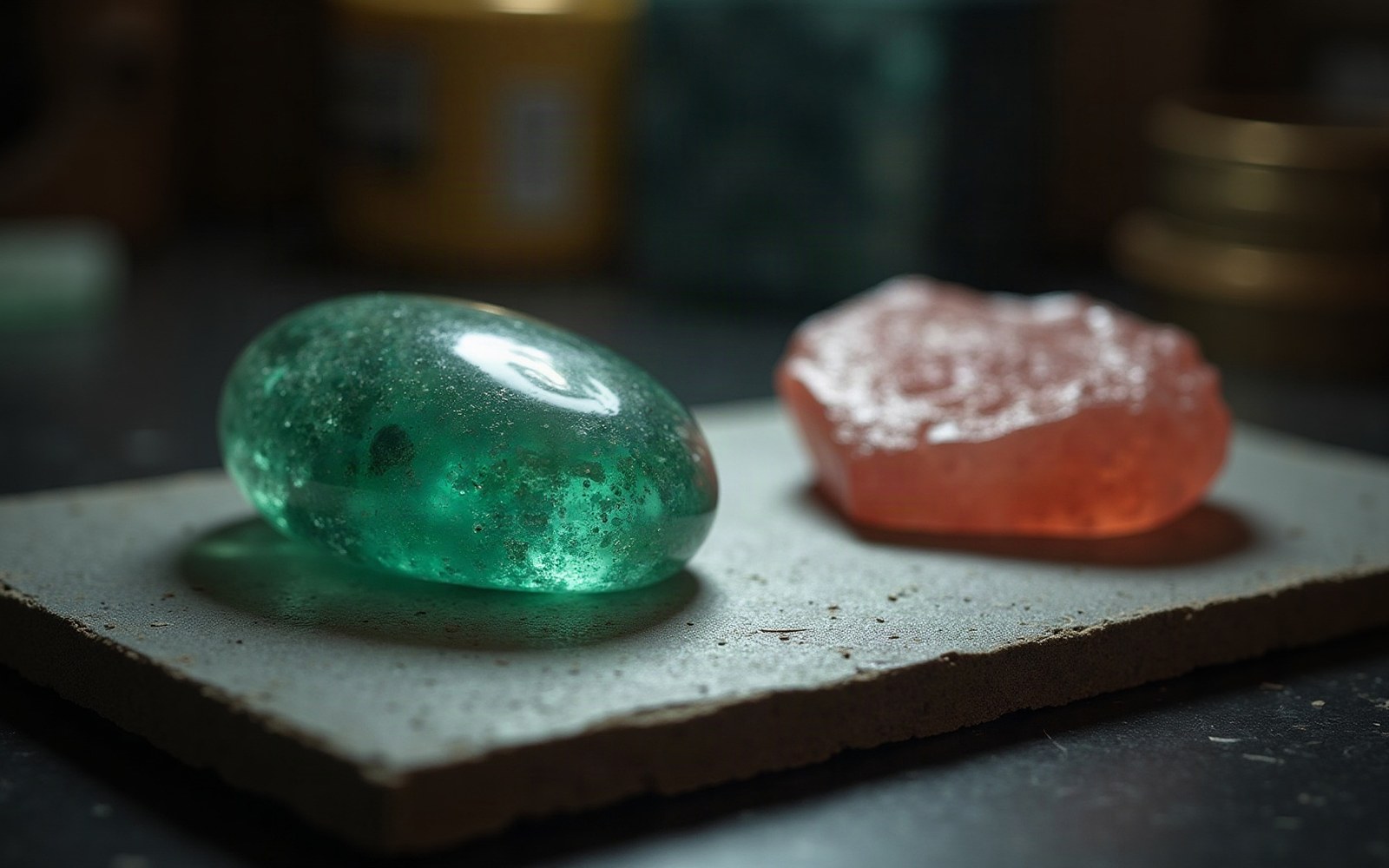
One Name, Two Crystal Structures
For most of recorded history, jade meant a single substance — hard, tough, worked into ritual and ornamental objects across cultures separated by oceans. The Palace Museum in Beijing holds imperial Chinese carvings documented to the Zhou dynasty (roughly 1046–256 BCE), all carved from what artisans called yu, a term that covered both materials without distinction. The separation came from French mineralogist Alexis Damour, who in 1863 analysed samples from different sources and demonstrated that what the trade called jade comprised two chemically distinct silicates.
The first is nephrite, a calcium-magnesium-iron amphibole with a fibrous interlocking structure that makes it exceptionally tough. Nephrite was the jade of ancient China's imperial workshops, sourced primarily from Khotan in Xinjiang. New Zealand nephrite was worked separately by Māori carvers, who called it pounamu. The second is jadeite, a sodium-aluminium pyroxene with a granular interlocking texture and a higher refractive index (around 1.66, compared to nephrite's 1.60–1.63). Jadeite comes overwhelmingly from a single geological source: the Hpakant valley in Kachin State, Burma, where tectonic subduction created the unusual high-pressure, low-temperature conditions required for its formation.

Also in The Drawer: Spinel Borrowed Ruby's Colour, Mine, and Name
Photo: Arrival of the Imperial State Crown · Wikimedia Commons
The two minerals have different specific gravities — jadeite at roughly 3.2–3.4 and nephrite at 2.9–3.1 — a distinction measurable with hydrostatic weighing. Under spectroscopic analysis, they separate decisively, and GIA gemological testing uses both refractive index and infrared spectroscopy to identify which mineral is on the bench. In practice, however, street markets, auction descriptions and even some trade documentation continue to apply "jade" to both without qualification.
Imperial preference matters here. By the Qing dynasty, Burmese jadeite — particularly the saturated green variety known in trade as feicui, coloured by iron and chromium — had overtaken nephrite in court favour. The distinction was cultural before it was mineralogical, and the mineralogists merely confirmed in chemistry what Chinese connoisseurs had already noted in colour, translucency and feel. That jadeite and nephrite share a name is not ignorance on the trade's part; it is a very old habit that science clarified but did not dislodge.
Related