Red, but Not Corundum
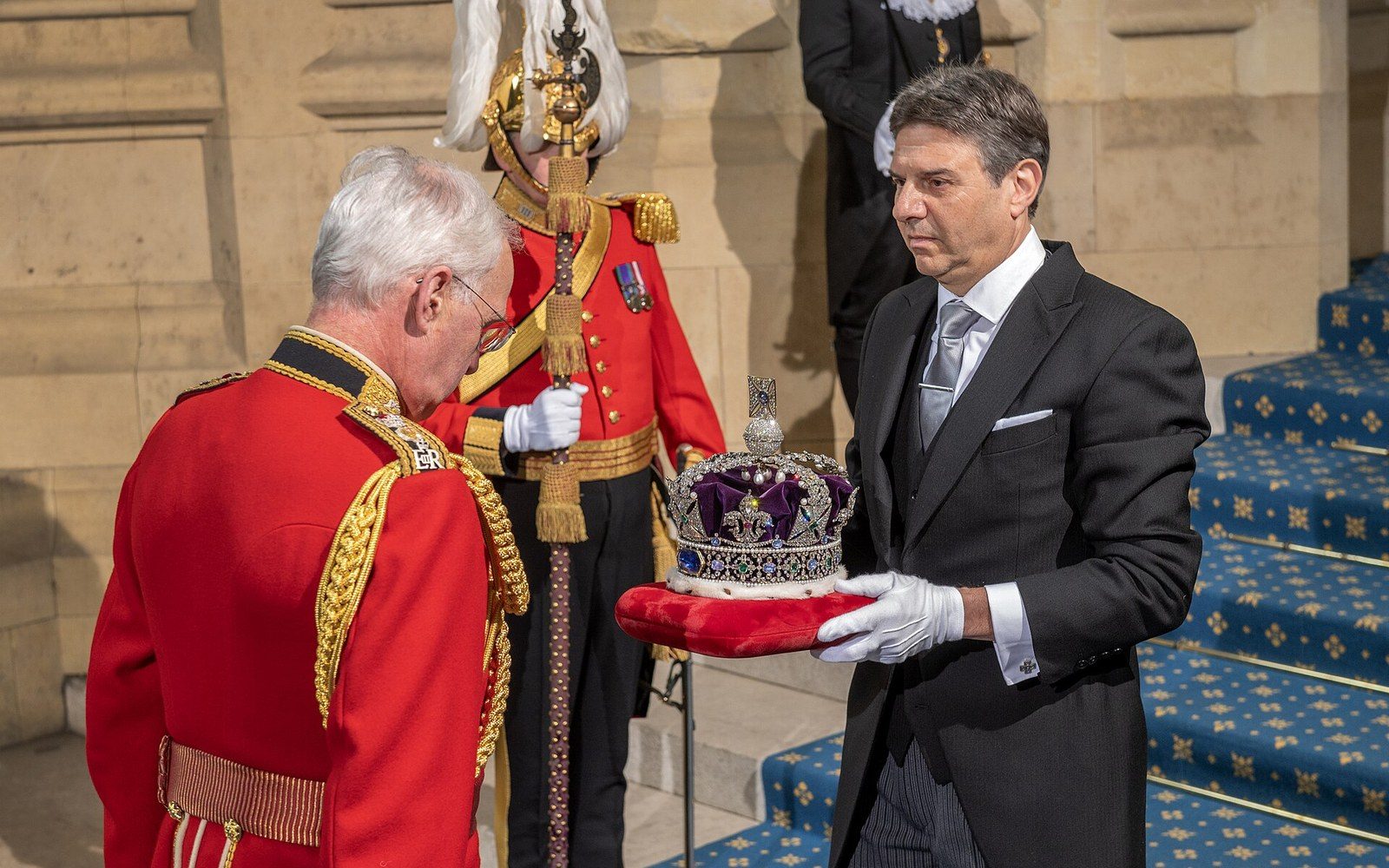
The stone set into the front of the Imperial State Crown — an irregular, polished cabochon weighing approximately 170 carats, deep red, with a history traceable to fourteenth-century Castile — is not a ruby. It is a spinel. Mineralogists established this in 1783, when the chemical distinction between spinel (magnesium aluminium oxide, MgAl₂O₄) and corundum (aluminium oxide, Al₂O₃) was first made with analytical rigour. The stone's name, inherited from Edward of Woodstock, the Black Prince, who is said to have received it from Pedro I of Castile in 1367, survived the reclassification intact. The name was easier to keep than to correct.
The confusion was not carelessness. To the unaided eye, gem-quality red spinel and ruby can be nearly indistinguishable: both owe their colour primarily to chromium, both crystallise in forms that produce similarly saturated reds, and both occur in the same geological settings — notably the marble-hosted deposits of the Mogok valley in Burma, where ruby and spinel are found together in the same pockets of calcium-rich metamorphic rock. Without spectroscopy or crystal-structure analysis, a medieval jeweller had no tool that would separate them.

Also in The Drawer: Coober Pedy Produces White Opal; Lightning Ridge Produces Black, and the Difference Is the Dirt
Photo: Jose E. Caceres Erbina / Pexels
Balas Ruby: A Category Built on a Misidentification
The historical trade gave this confusion its own vocabulary. Stones described as "Balas rubies" — the term balas deriving from Balakhshan, the medieval name for the Badakhshan region of what is now northeastern Afghanistan — were almost always red spinel. The Sar-e-Sang workings in Badakhshan are best known today for lapis lazuli, but the region also yielded red and pink spinels that entered the medieval gem trade routed through Persia and the Levant. European courts received them as rubies of a particular provenance type; the "Balas" qualifier indicated origin, not species — and the species was wrong for centuries.
The chemical reason the confusion persisted so long is instructive. Spinel and corundum share no crystal structure: spinel forms in the cubic system, corundum in the trigonal. Their refractive indices differ measurably — corundum sits near 1.76–1.77, spinel near 1.71–1.73 — but refractometry as a practical gemmological tool did not exist until the late nineteenth century. Before that, hardness offered a partial clue: corundum at 9 on the Mohs scale is significantly harder than spinel at 8. But hardness testing on a mounted crown jewel was not a realistic option, and the visual similarity was enough to sustain the misidentification across four centuries of recorded European gem history.
The Gemological Institute of America's grading framework and modern spectroscopic analysis have since documented how widespread the error was. Several stones in European royal collections that were catalogued as rubies have been reclassified. The Black Prince's Ruby is simply the most visible example, partly because it sits at the centre of the Imperial State Crown and is described precisely in official records, making it the most thoroughly documented case.
What distinguishes spinel, once properly identified, is not inferiority. Fine red spinel from Mogok — the locality produces both — commands serious prices at auction and is now graded on its own terms. The correction of 1783 did not diminish the stone; it simply gave it its right name. The Black Prince's Ruby remains where it has been for well over a century: on the crown, above the Cullinan II diamond, entirely itself — a spinel, approximately 170 carats, unheated, with one of the longer documented provenances of any gem in any collection.
Related