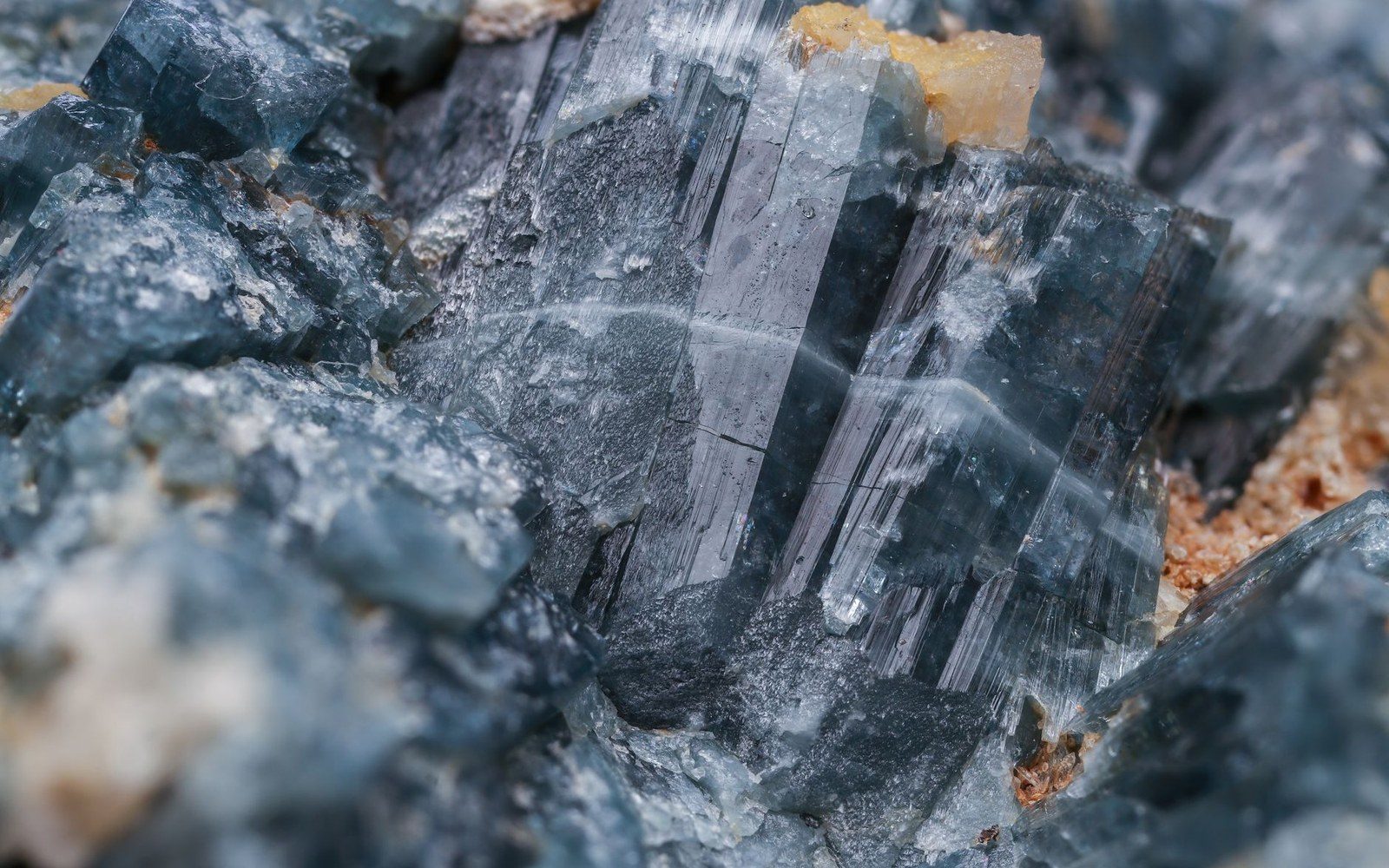
The Structure That Accepts Almost Everything
Tourmaline is a boron-silicate mineral with one of the most compositionally tolerant crystal structures in mineralogy. Its general formula accommodates a long list of substituents in several distinct crystallographic sites, meaning iron, manganese, lithium, aluminium, copper and other elements can all slot into the lattice without collapsing it. Each substitution shifts which wavelengths of light the crystal absorbs, producing a different colour — sometimes two or three within a single crystal, a phenomenon called colour zoning.
Iron produces blue-green indicolite. Manganese drives the pink-to-red rubellite. Copper, in trace concentrations, creates the vivid blue-green of Paraíba tourmaline, first documented from deposits in Paraíba state, Brazil, and later found in Nigeria and Mozambique. The copper-bearing material from all three localities is mineralogically identical, and the Gemological Institute of America now applies the Paraíba designation on the basis of copper content confirmed by laboratory analysis, regardless of geographic origin.

Also in The Drawer: Spinel Borrowed Ruby's Colour, Mine, and Name
Photo: Arrival of the Imperial State Crown · Wikimedia Commons
Deposits and Their Signatures
Brazil's Minas Gerais state has been the world's dominant tourmaline source since the eighteenth century, producing the full colour range from the pegmatite-hosted deposits around Governador Valadares and Araçuaí. Pegmatite — the very coarse-grained igneous rock in which tourmaline crystallises from late-stage magmatic fluids — also hosts the gem material at Kunar and Nuristan in Afghanistan, which yields fine indicolite and multi-coloured stones. The original Paraíba discovery in the late 1980s was geologically anomalous: a relatively small pegmatite body in northeastern Brazil, not the established southern gem districts. Nigerian and Mozambican Paraíba, confirmed in the early 2000s, comes from similar pegmatitic environments in the Pan-African orogenic belt.
Mozambique, particularly the Alto Ligonha district, has become a major commercial source of rubellite and copper-bearing tourmaline since the 2000s. The country's output has materially shifted the global supply of high-colour material.
Because tourmaline's colour arises from multiple independent chemical mechanisms rather than a single chromophore, no two deposits produce an identical population of colours — making the mineral a useful geochemical fingerprint as well as a gemstone.
Related