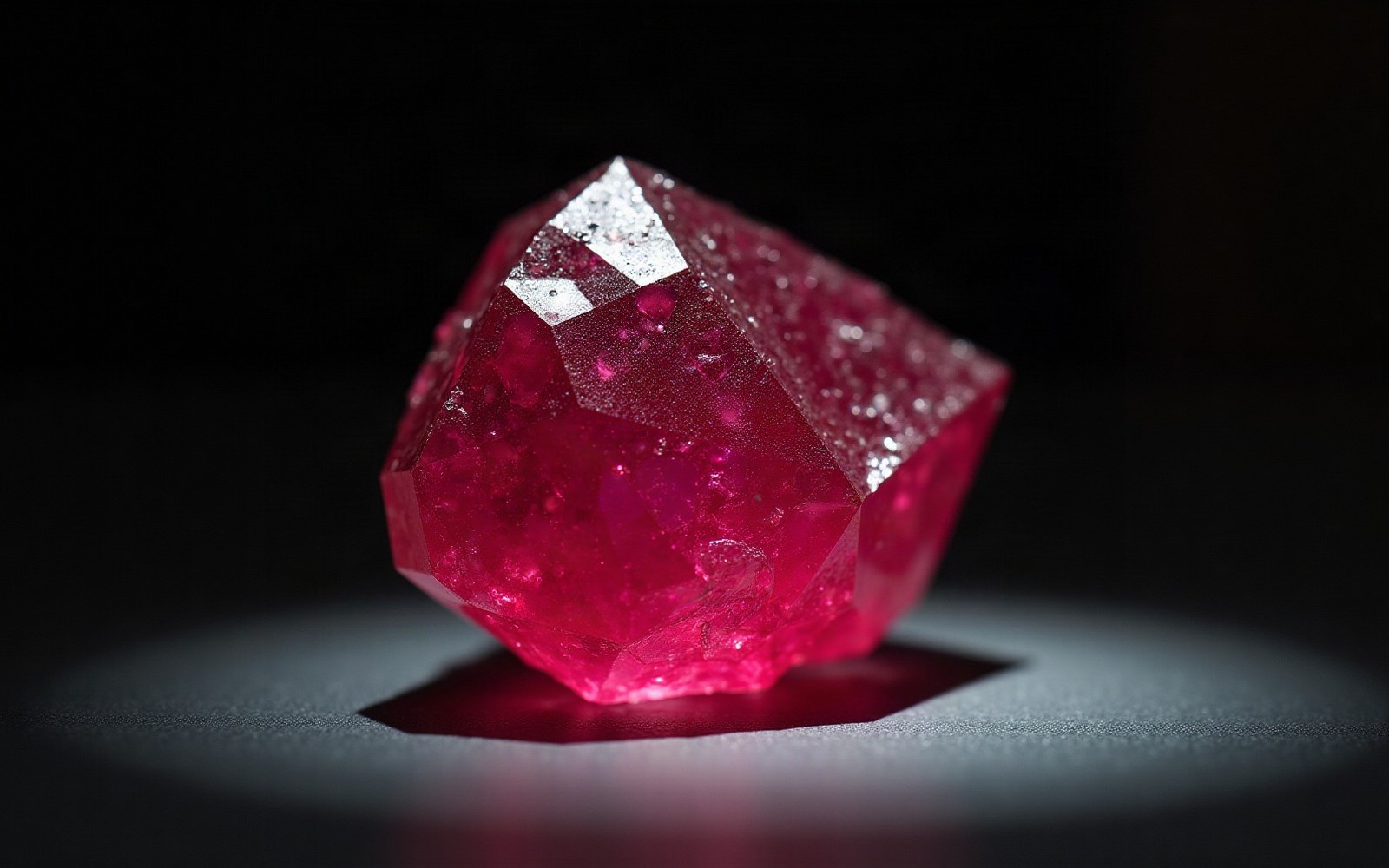
One Lattice, Two Atoms
Corundum's crystal structure is trigonal: aluminium ions sit within an oxygen framework arranged in a pattern that the International Union of Crystallography classifies in the hexagonal system, with aluminium occupying two-thirds of the available octahedral sites. That geometry matters beyond taxonomy. The spacing between oxygen atoms dictates the exact size of the gap any substituting ion must fill, and chromium — atomic radius close enough to aluminium's to slip into the lattice without collapsing it — does exactly that. Where Cr³⁺ replaces Al³⁺, the optical behaviour of the mineral changes entirely.
Chromium's outer electrons absorb strongly in the yellow-green part of the visible spectrum, roughly 550–600 nm, and to a lesser degree in the violet. What passes through is red; what the crystal then re-emits by fluorescence is also red, deep into the 690 nm range. The combined effect of transmission and fluorescence is what gives Mogok ruby its famous internal fire — a glow that distinguishes it from garnets or glass at a glance. Chromium also makes corundum fluorescent under ultraviolet, a characteristic GIA gemologists routinely use during origin testing because the fluorescence intensity correlates with chromium concentration and is suppressed by iron content.
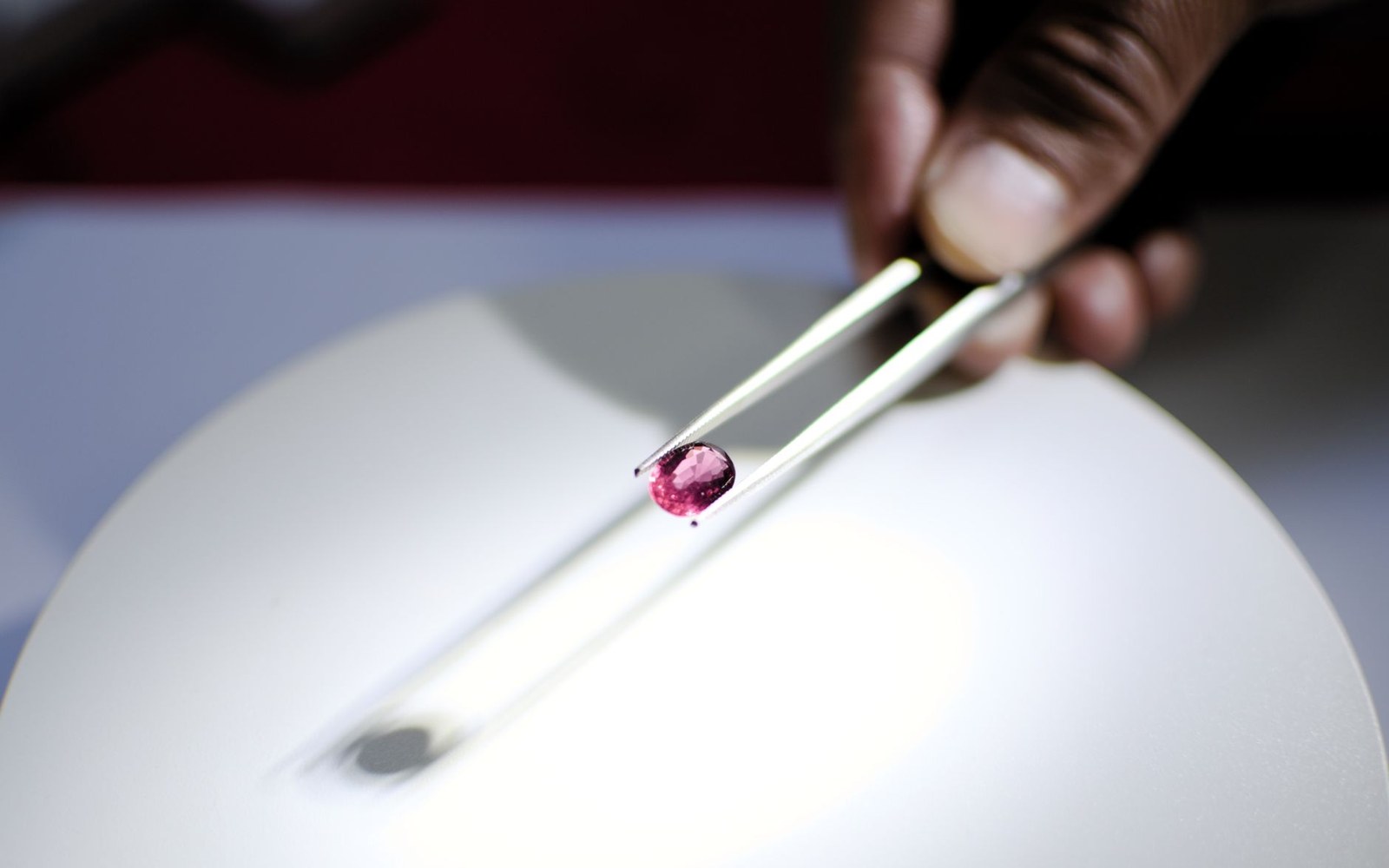
Also in Corundum: Ruby and Sapphire Are One Mineral, and the Trade Knows It
Photo: Jorge Romero / Pexels
Why Pink Is Not Just Pale Red
The question of where ruby ends and pink sapphire begins has generated more trade argument than almost any other colour boundary in gemmology. Mineralogically, the two are the same species — corundum coloured by the same chromium mechanism — and the GIA's formal grading framework treats the distinction as one of saturation, not chemistry. In practice, the threshold is a matter of convention, not physics.
At very low chromium concentrations, the lattice absorbs less yellow-green, the transmission band widens, and the eye reads the result as pink rather than red. Fluorescence is still present — pink sapphire fluoresces under ultraviolet — but the re-emitted light is not intense enough to push the overall appearance across the saturation threshold the trade requires of a ruby. What changes between a 0.1 percent and a 0.5 percent chromium substitution rate is not the mechanism but the depth of absorption, and depth of absorption is the whole of colour in a gem mineral.
Iron complicates this further. Iron ions, when present alongside chromium, act as fluorescence quenchers: they absorb at wavelengths that overlap with chromium's emission band and return that energy as heat rather than light. This is why rubies from iron-rich sources — certain deposits in Thailand's Chanthaburi province, for instance — tend toward darker, less luminous reds than stones from Mogok, Burma, where the crystalline marble host rock imposes a low-iron environment. The marble geology at Mogok, documented in detail by the Gemological Institute of America's origin research, is not incidental to colour; it is constitutive of it.
The Frame That Holds the Chemistry
Corundum's refractive index — approximately 1.762 to 1.770, uniaxial negative — is a direct consequence of the same trigonal lattice that controls chromium substitution. Light travelling through the crystal encounters two different velocities depending on its orientation relative to the c-axis, making corundum doubly refracting. A gemologist measuring birefringence of around 0.008 on a refractometer has confirmed the crystal system before the colour is even considered.
That optical architecture also governs asterism in star rubies and star sapphires. Rutile inclusions precipitate during cooling along the three symmetry directions of the trigonal lattice, each set at 60 degrees to the others, producing the six-rayed stars visible in cabochon-cut star stones. The lattice imposes the geometry; the inclusions merely comply. Hardness of 9 on the Mohs scale — second only to diamond — follows from the strength of the Al–O bond in the same structure.
Colour in corundum, then, is never a surface property. It is the result of a specific ion in a specific site absorbing specific wavelengths, all of it constrained by a lattice whose geometry was fixed when the crystal nucleated. Chemistry produces the hue; the lattice provides the frame that chemistry has no choice but to work within.
Related