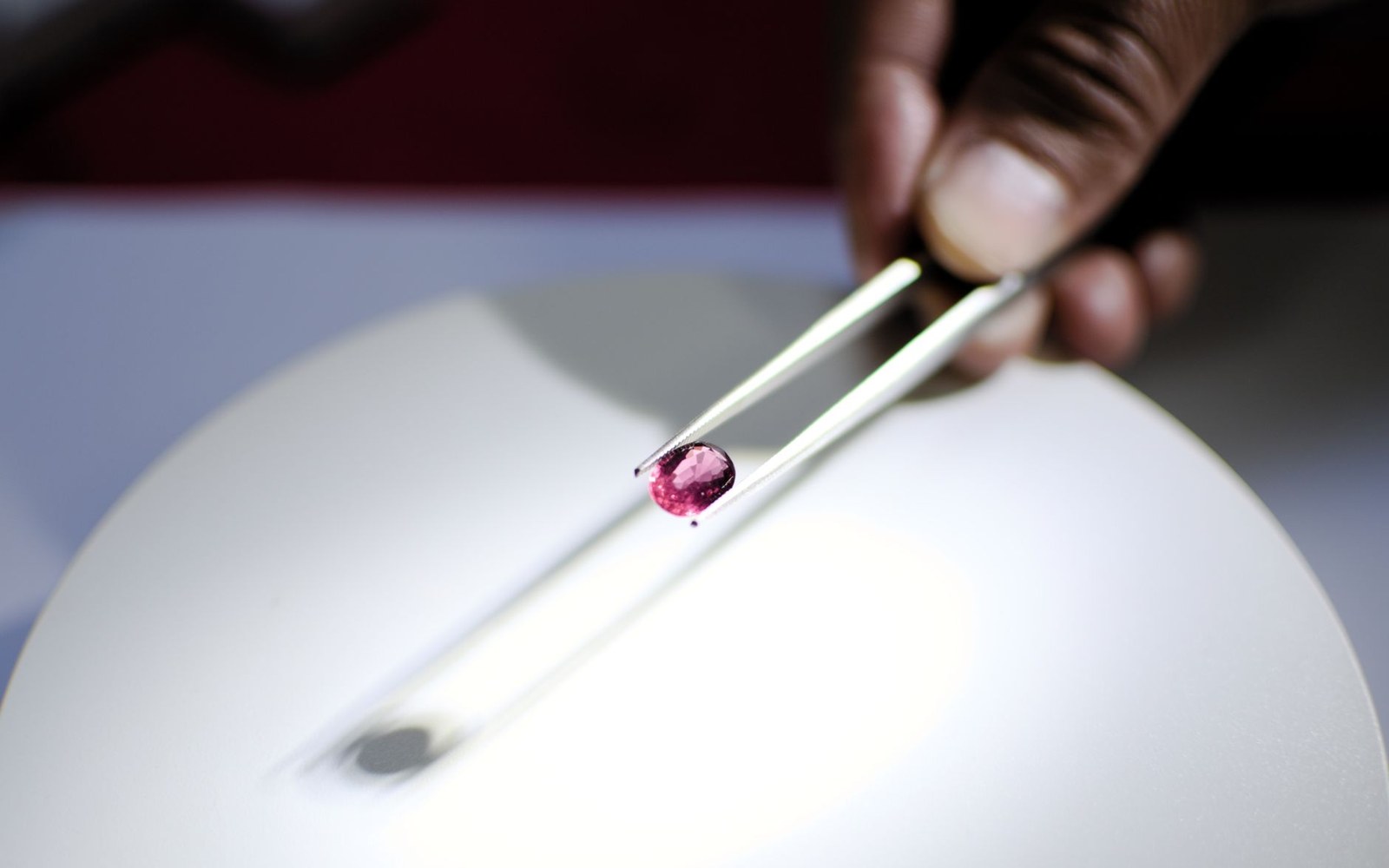
One Formula, Two Markets
Corundum — aluminium oxide, Al₂O₃ — is a colourless mineral in its pure state. Every ruby in every museum vitrine and every blue sapphire in every estate parcel is corundum. The host lattice does not change. What changes, in quantities measured in parts per million, are the trace elements that substitute for aluminium at specific sites within the crystal structure. Chromium produces the red of ruby. Iron and titanium, acting together, produce the blue of sapphire. The Gemological Institute of America's standard reference materials confirm that ruby and sapphire carry separate names only because the trade decided, at some historical moment, that one deserved a separate market.
That decision was commercially rational. A fine ruby from Mogok, Burma — the fluorescent, pigeon-blood material from the marble-hosted deposits of the Mogok valley — commands prices per carat that blue sapphires rarely reach. Naming matters enormously to the market. What it does not do is reflect a mineralogical boundary, because no such boundary exists in the chemistry.
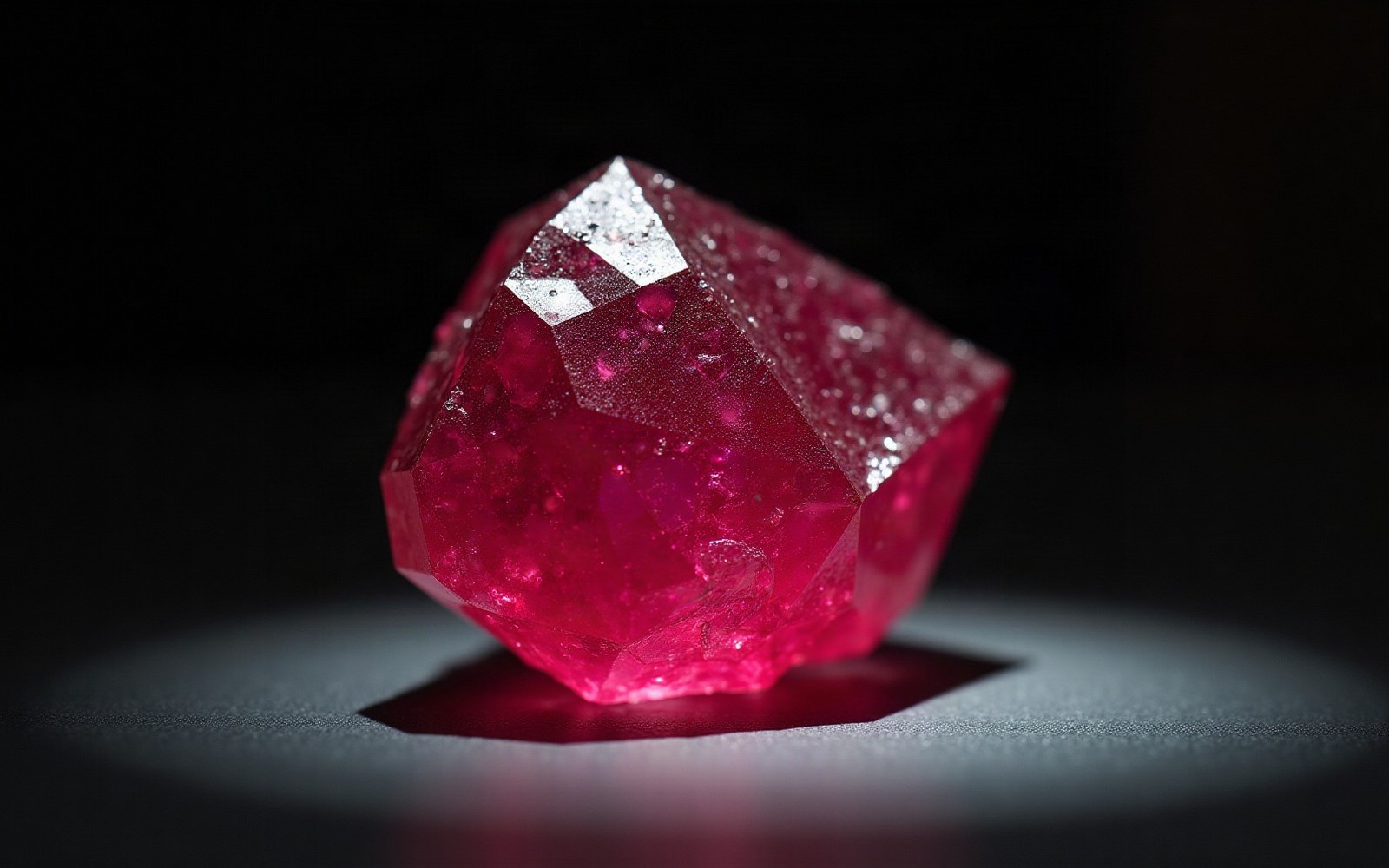
Also in Corundum: Colour Is Chemistry, Shape Is the Lattice
Where the Spectrum Becomes a Problem
The difficulty concentrates in the middle of the colour range. A stone saturated enough to read as red but carrying enough iron to pull the hue toward orange-red, pinkish-red, or purplish-red sits in territory where two graders can disagree in good faith. The GIA, in its laboratory reports, draws the ruby boundary at stones that display red as their dominant hue, but it also documents the commercial sensitivity of the call: a stone reclassified from ruby to pink sapphire can lose a significant fraction of its sale price without losing a single atom of chromium.
Pink sapphire is itself a relatively recent trade category. For much of the modern era the trade acknowledged ruby, and shaded everything lighter as "inferior ruby" rather than granting it a distinct designation. The formalisation of pink sapphire as a named category solved a grading problem by creating a naming problem — the pink-to-red transition is continuous, and the cut-off is not written in the crystal.
Padparadscha, the pinkish-orange sapphire from Ratnapura, Sri Lanka, occupies an adjacent disputed zone. It is neither ruby nor standard sapphire; it is a trade name for a specific chromium-iron combination whose saturation boundaries the GIA, the Gübelin Gem Lab, and SSEF have each defined slightly differently. Three laboratories examining the same stone have, on documented occasions, issued different category designations.
The Mohs Number They Share
Both ruby and sapphire score 9 on Friedrich Mohs's 1812 hardness scale — one step below diamond at 10, and meaningfully harder than every other common gemstone. That shared 9 is not incidental: it follows directly from the aluminium-oxide lattice both varieties inhabit. The lattice is the same. The hardness is the same. The refractive index range is effectively the same, approximately 1.76 to 1.77, and the trigonal crystal symmetry is the same. The asterism that appears in star rubies and star sapphires arises from the same mechanism: needle-like rutile inclusions oriented along the crystal axes, producing a six-rayed reflection in cabochon-cut stones.
The only mineralogically defensible statement the trade cannot make is that ruby and sapphire are different minerals. Georg Agricola, writing in the sixteenth century, had no unified mineralogy and can be forgiven the confusion. The modern trade, operating under GIA laboratory standards and spectroscopic analysis, has no such excuse — and has chosen, with full knowledge, to maintain the distinction anyway. That is not a criticism. It is a precise description of how commercial gemology works: chemistry sets the outer limits, and convention fills the space within them.
Related