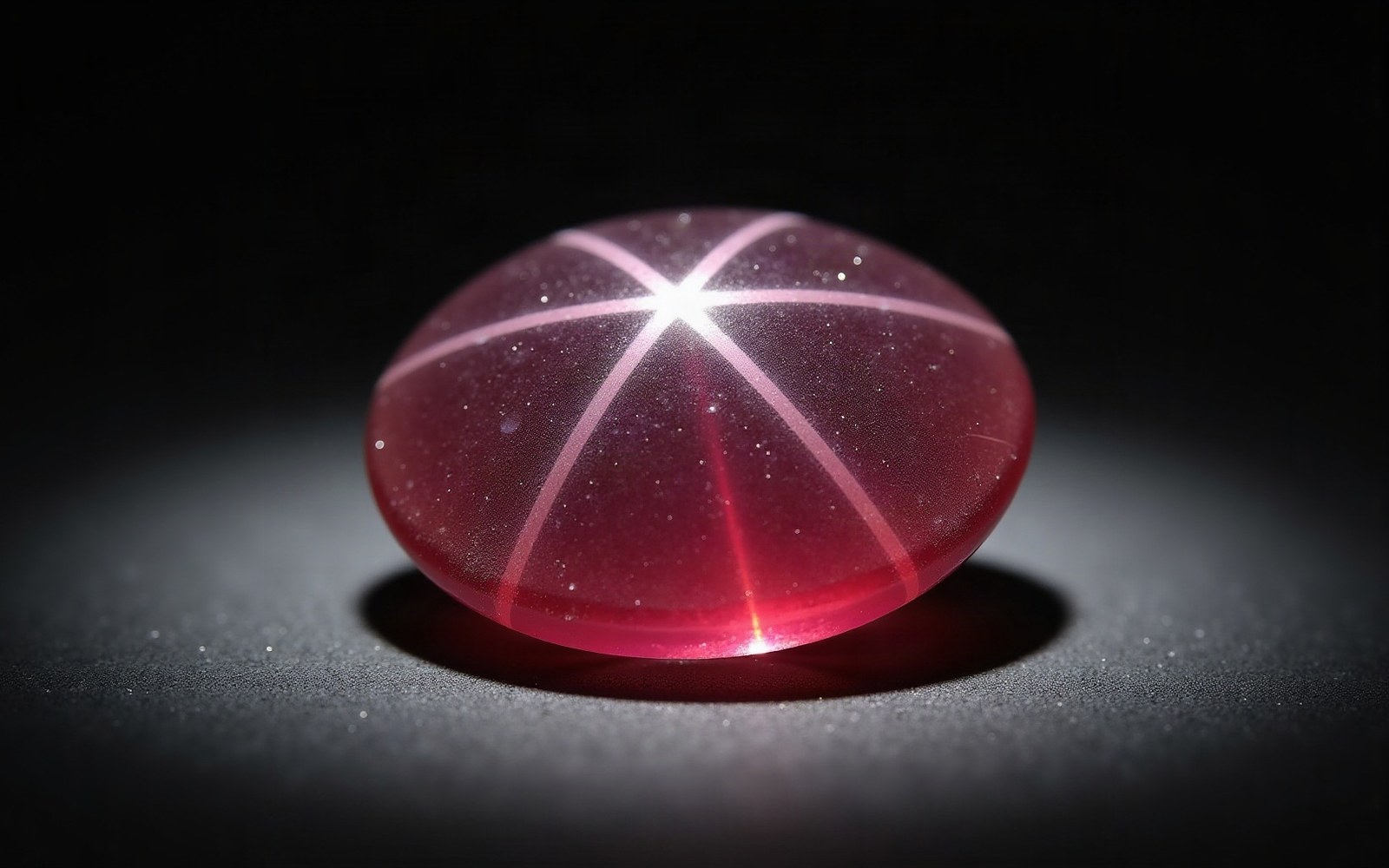
Asterism in corundum is a consequence of geometry. Within a ruby or sapphire crystal, titanium and oxygen atoms expelled during cooling precipitate as rutile — titanium dioxide — in fine needles called silk. Because the corundum crystal lattice has hexagonal symmetry, those needles align along three equivalent axes, each separated by sixty degrees. When a single light source strikes the stone, each set of parallel needles reflects a blade of light perpendicular to its own orientation. Three blades, crossing at a common point, produce the six-rayed star.
The mechanism works only when the stone presents a smooth, curved surface to the light — which is why cabochon cutting is obligatory. A faceted stone would scatter the reflected blades across dozens of planes and dissolve the pattern entirely. The cutter must also orient the dome's apex precisely over the crystal's c-axis, the vertical symmetry axis of the hexagonal lattice; even a few degrees of misalignment causes the star to migrate toward the girdle and lose sharpness. Achieving this while retaining maximum weight from a rough crystal is among the more demanding decisions in gem cutting.
Also in Corundum: Ruby and Sapphire Are One Mineral, and the Trade Knows It
Photo: Jorge Romero / Pexels
The Star of India, at 563.35 carats per the American Museum of Natural History, is the most frequently cited large star sapphire in documented collections. Mined in Sri Lanka and donated to the museum by J. P. Morgan in 1900, it displays stars on both its dome and its flat base — a double star made possible by silk layers distributed through the depth of the stone rather than concentrated near one face. The DeLong Star Ruby, also held by the American Museum of Natural History at 100.32 carats, was recovered from Mogok in Burma and acquired in 1937; it is the standard reference point for a transparent, well-centered ruby star.
Silk density governs both the star's visibility and the body colour. Sparse silk leaves the colour saturated but the star faint; dense silk brightens the star while dulling and greying the ground colour. The finest Mogok material threads this balance — enough rutile to produce a sharp, mobile star that shifts cleanly as the light source moves, without so much that the characteristic pigeon-blood red is lost beneath a milky haze. That balance is rare, which is why the DeLong stone remains a benchmark more than eighty years after it entered the collection.
Related