The Optics Dictate the Shape
A faceted stone earns its brilliance by refracting and internally reflecting light through a precise geometry of flat, angled planes. That logic breaks down entirely when the optical phenomenon a stone displays is a surface effect, not a volumetric one — and three gem types illustrate the principle with unusual clarity.
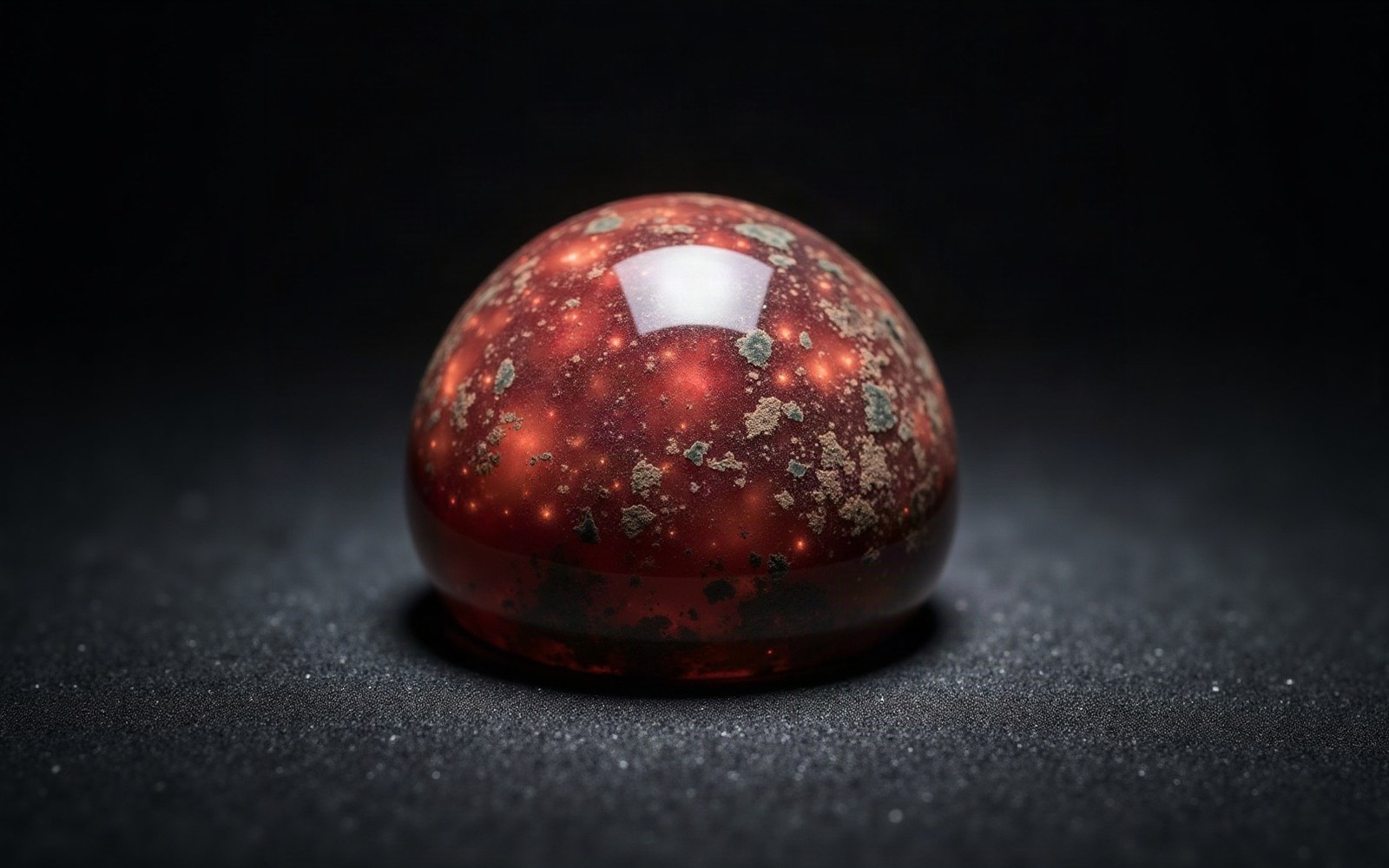
Precious opal owes its play-of-colour — the spectral flash that moves as the stone tilts — to a regular lattice of amorphous silica spheres, typically 150 to 300 nanometres in diameter, that diffracts white light into its component wavelengths. The phenomenon occurs at and just beneath the surface of the gem layer; cutting facets into that layer severs the diffracting arrays and scatters the effect into incoherence. A smooth, gently curved dome preserves the continuous sheet of spheres and lets the viewer's eye move across the colour as the viewing angle changes. Flat facets would create competing reflections that visually suppress the very phenomenon that makes the stone valuable.
Also in Cutting: Three Numbers from 1919 That Nobody Has Managed to Improve On
Star stones — star rubies, star sapphires, star diopsides — present a different but structurally related problem. Asterism arises from needle-like rutile inclusions oriented along specific crystal axes: each set of parallel needles reflects a band of light, and two or three intersecting sets produce the characteristic six-rayed star. That reflected band only converges into a sharp, centred star when the stone's curved surface acts as a convex mirror, focusing the reflection toward the observer's eye. On a faceted crown, each flat plane reflects its own fragment of the bands independently; the star dissolves into a blur. The base of the stone must sit at the correct depth below the dome for the star to float at the surface — lapidaries working Star of India-type material orient the rough so the star's apex aligns with the optical axis of the finished cabochon before a single gram is removed.
Cat's-eye chrysoberyl — the finest examples emerging from Sri Lanka's Ratnapura gravels — displays chatoyancy by the same needle-reflection mechanism, but from a single family of parallel inclusions rather than two or three. The dome focuses those reflections into a single luminous line across the stone's width; the sharpness of the "eye" depends directly on how tightly the lapidary holds the curvature relative to the inclusion plane.
The cabochon itself is not one standard form. A high, steep dome — used for translucent or opaque material — maximises the focusing effect. A lower, flatter profile suits transparent star stones where the body colour is itself part of the visual appeal. A double cabochon, curved on both faces, suits thicker stones with enough depth of body to carry a rounded back; opal doublets, where a thin gem layer is bonded to a backing for protection, are usually cut with a domed top and a flat base. Each variant is a calculated response to what the specific material's structure actually does with light.
Related