The Thesis That Became a Template
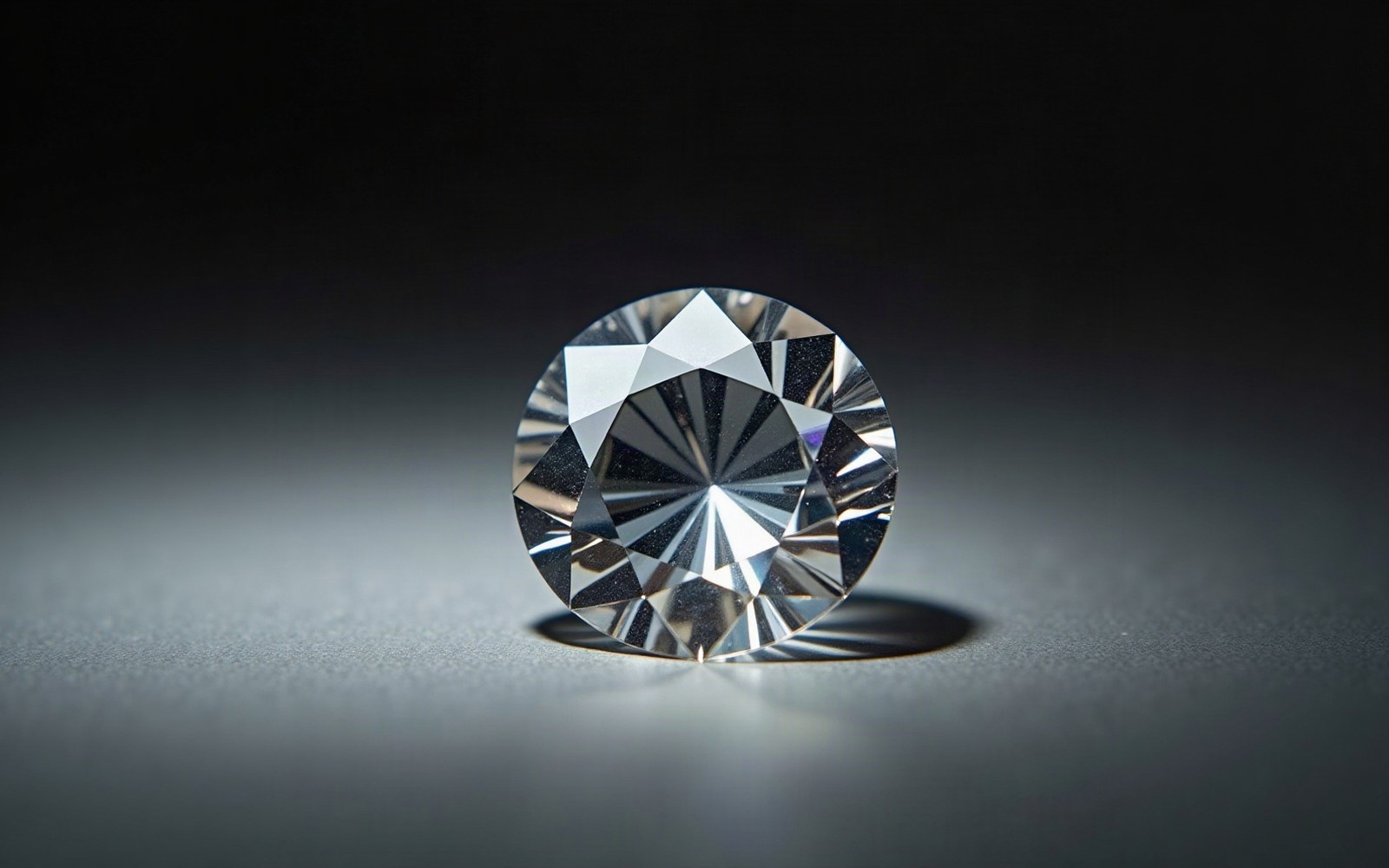
In 1919, Marcel Tolkowsky submitted a doctoral thesis to the University of London titled Diamond Design: A Study of the Reflection and Refraction of Light in a Diamond. He was about twenty years old and had grown up in Antwerp, inside a family that had been cutting diamonds for generations. His method was not empirical — he did not cut hundreds of stones and inspect them. He worked from first principles: the refractive index of diamond (2.417), the critical angle at which total internal reflection occurs, and the trigonometric relationships between facet angles and the path of light through the stone. From those inputs he derived three numbers that the trade has been arguing about, refining and largely confirming ever since.
The crown angle he specified was 34.5 degrees, measured from the girdle plane. The pavilion angle was 40.75 degrees. The table diameter was 53 percent of the girdle diameter. The geometry was designed to do two things simultaneously: maximise brilliance — white light returned upward through the crown — and preserve fire, the dispersion of white light into spectral colour that gives a well-cut diamond its flashes of red, orange and violet. Tolkowsky recognised that the two objectives trade off against each other. Steepen the pavilion beyond his figure and light leaks out the bottom; shallow it and brilliance suffers. His paper, available through the archive of early gemmological literature, is a compact exercise in applied optics, not a long book.
Also in Cutting: The Rose Cut Came Before Anyone Could Do the Arithmetic
From Workshop Calculation to Industry Standard
For decades Tolkowsky's proportions lived as a benchmark in the cutting community rather than a codified rule. Cutters in Antwerp and, increasingly, in Surat adapted the model to commercial realities: preserving rough weight often meant accepting pavilion angles or table sizes that deviated from his ideal. The Gemological Institute of America formalised what Tolkowsky had described in geometric terms when it published its cut grading system as part of the broader diamond grading methodology developed under Robert Shipley's leadership and subsequently refined through the mid-twentieth century. The GIA's Excellent cut grade is defined by a range of acceptable proportions, not a single point — but the centre of that range sits close enough to Tolkowsky's 1919 figures that his thesis remains the conceptual origin of every round brilliant assessment conducted today.
The GIA's research division spent years running ray-trace modelling on thousands of proportion combinations to establish where cut quality actually falls off. Its findings, published in the early 2000s, confirmed that no configuration meaningfully outperforms the Tolkowsky zone for combined brilliance and fire in a round brilliant. The target shifted slightly: modern GIA Excellent stones are typically graded with table percentages in the 54–57 percent range and pavilion angles of 40.6–41.0 degrees, a modest adjustment rather than a revision. Tolkowsky's core insight — that these two angles and this ratio are the critical variables, and that they interact — has not been overturned.
What the Numbers Actually Mean
The round brilliant as cut today has fifty-eight facets: thirty-three on the crown and twenty-five on the pavilion, counting the culet as a single point. Every facet angle is ultimately downstream of the three figures Tolkowsky specified, which is why his thesis is the natural reference point for discussing the GIA's cut-colour-clarity-carat system developed in the following decades. The crown angle controls how much dispersion the observer sees; the pavilion angle controls how completely light is returned rather than lost through the base; the table percentage controls the balance between the two effects.
What Tolkowsky produced in 1919 was not a recipe found by trial and error but a derivation from physical constants. The refractive index of diamond has not changed. The geometry of a round brilliant has not changed. The three numbers have not changed in any way that matters.
Related