Antwerp and the Craft Tradition
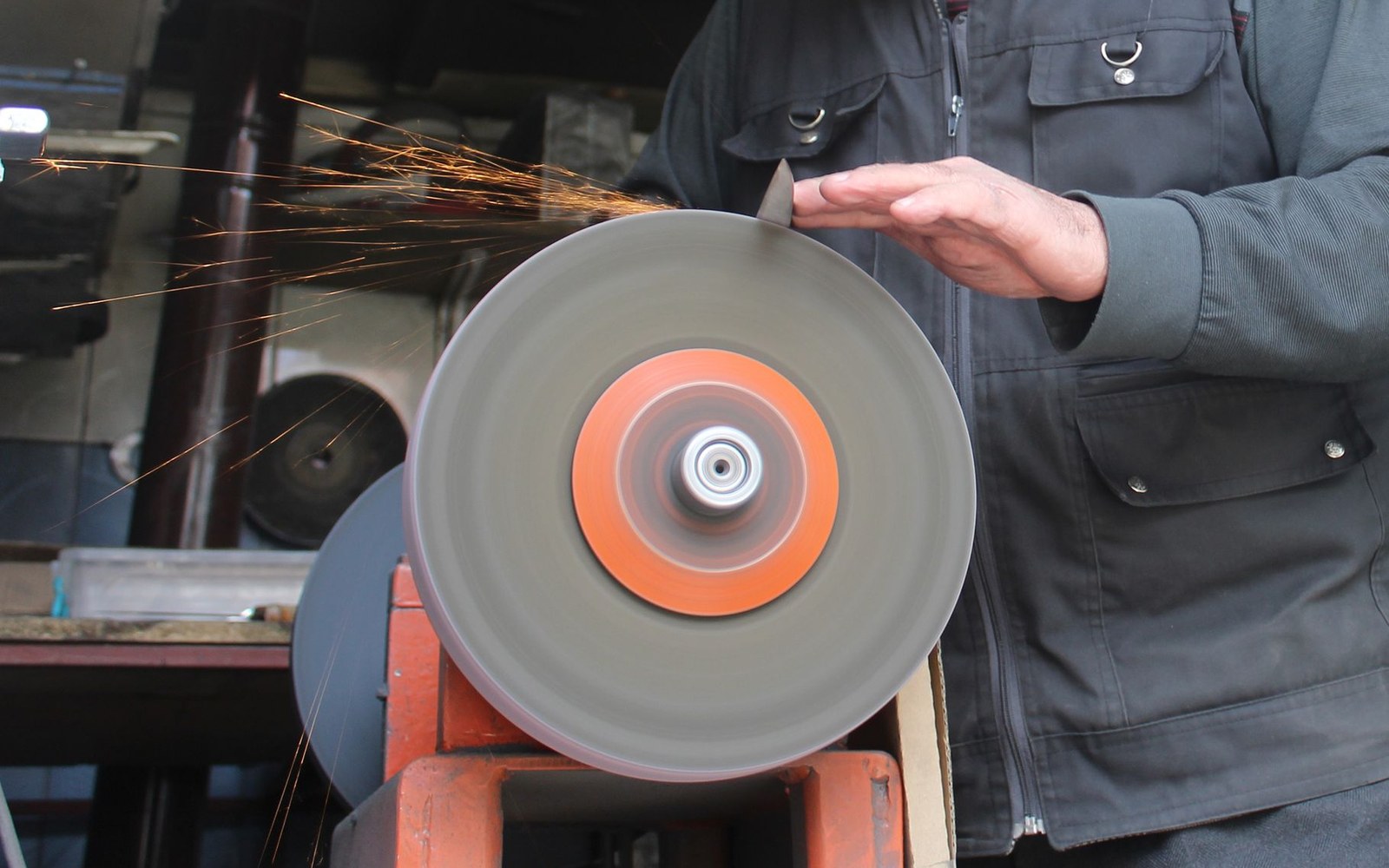
Antwerp's connection to diamond cutting is documented from the 1470s, when the Flemish city displaced Bruges as the commercial centre of the Low Countries and attracted the craftsmen who followed capital. The earliest guild records for diamond workers in Antwerp date to the final decades of the 15th century, and by the 1520s the city held a near-monopoly on European cutting, fed by Portuguese trade routes carrying rough from the Indian subcontinent. The tools were simple — a polishing wheel, called a scaif, charged with a paste of diamond dust and oil — but the technique was demanding: diamond cuts diamond, and the powder that abrades a facet is made from the same material.
Through the 16th and 17th centuries, Antwerp and its rival Amsterdam competed for the same supply of Indian rough, and cutters in both cities developed the rose cut and the early brilliant forms that eventually provided the mathematical foundation Marcel Tolkowsky formalised in his 1919 thesis. The craft concentrated in Antwerp's Jewish community, where skills passed through family workshops across generations. When rough from the Kimberley discoveries in South Africa poured into the market after 1871, it was Antwerp and Amsterdam that processed the bulk of it. The Asscher Diamond Company in Amsterdam cut the Cullinan in 1908; Antwerp's workshops handled the commercial tonnage. Even today the Antwerp World Diamond Centre estimates that more than 80 percent of the world's rough and more than 50 percent of polished diamonds pass through the city at some point in the trading chain — though the meaning of "pass through" has changed considerably since the 1970s.
Also in Cutting: Three Numbers from 1919 That Nobody Has Managed to Improve On
Surat and the Scale Revolution
What changed it was labour economics and the deliberate development of an Indian cutting industry. Surat in Gujarat had a small, centuries-old tradition of finishing low-quality Indian rough, but the transformation into the world's dominant cutting centre by volume was a project of the 1960s and 1970s. Antwerp merchants, looking for a way to process the enormous quantities of small, near-gem rough that were uneconomical to cut in Belgium at Belgian wages, began routing that material to Gujarat through established Jain and Palanpuri trading networks that had long intermediated between African producers and European dealers. The result was rapid industrial scaling: factories of hundreds of polishers, each working a scaif not fundamentally different from the Antwerp original, producing small round brilliants in enormous numbers.
By the 1980s Surat was cutting the vast majority of the world's diamonds by number of stones, a statistic that remained true into the 2000s, when estimates placed more than 90 percent of the world's polished diamonds — by piece count — as processed in India, with Surat and the surrounding Gujarat towns at the centre. The gem-quality, high-value rough continued to move to Antwerp and, increasingly, to cutters in Tel Aviv and New York; what Surat handled was volume. An individual Surat polisher might finish dozens of one-pointer stones in a working day; a specialised Antwerp craftsman cutting a five-carat D-colour rough might spend days on a single stone.
The integration with GIA grading changed the industry's upper end. Robert Shipley founded the Gemological Institute of America in 1931, and its standardised four-Cs grading system, formalised in 1953, gave buyers a language to specify what they wanted regardless of where cutting happened. Antwerp's high-end workshops aligned their output to GIA standards because their clients demanded certificates. Surat's industry, processing commercial melee at scale, operated on different tolerances, though the largest Surat factories began seeking GIA grading for better-quality output as the export market demanded documentation.
The division that emerged is best understood as a supply-chain stratification rather than a competition. Antwerp remained the trading, grading and high-end cutting node; Surat became the world's polishing floor. The scaif that a Flemish craftsman charged with diamond dust in 1490 and the motorised wheel running in a Surat factory today perform the same physics on the same material. The scale separating them is, roughly, the scale separating a guild workshop from a small city's entire employed population.
Related