From Tavernier to the French Treasury
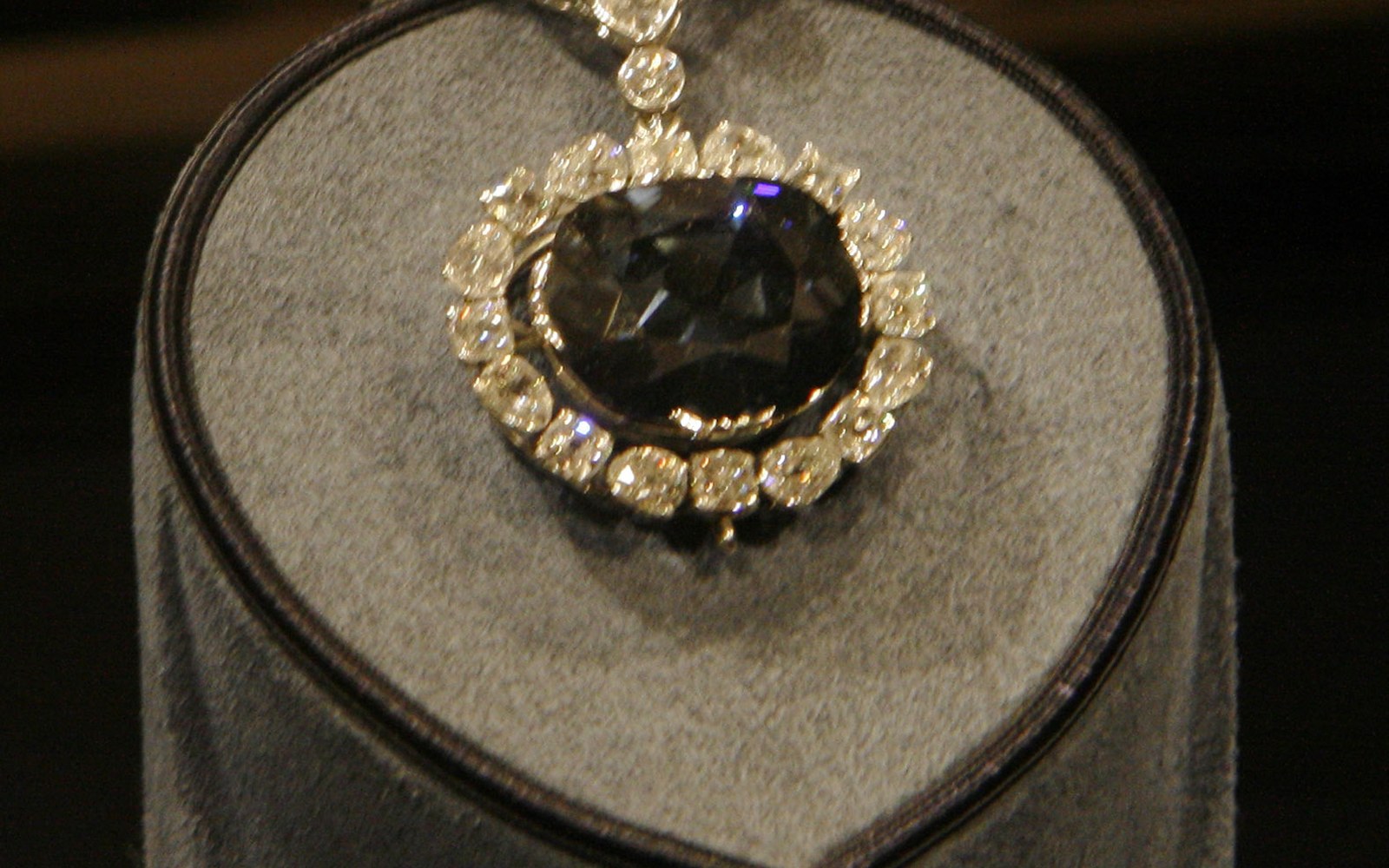
Jean-Baptiste Tavernier, a French merchant-traveller, purchased a large blue diamond in India in 1666. The stone weighed approximately 112 old carats — a unit somewhat smaller than the modern metric carat — and Tavernier described it in his 1676 account Les Six Voyages as a "beautiful violet." He sold it to Louis XIV in 1668 along with a parcel of other gems. The French crown's jewellers recut the stone to approximately 67.5 carats, a shape the court records called the Tavernier Blue; the recut produced what became known as the French Blue, which was set into a ceremonial order badge for the Order of the Golden Fleece.
The French Blue disappeared during the revolutionary pillaging of the royal jewel storehouse in September 1792, a loss recorded in state inventories. French law set a statute of limitations of twenty years on stolen goods, and the stone surfaced in London in 1812, precisely at that threshold. The London jeweller Daniel Eliason acquired it, and it was subsequently purchased — the exact route is not fully documented — by King George IV. After George IV's death in 1830 his debts required the dispersal of his estate, and the diamond passed through the trade again.
Also in Named Stones: Recut in 1852, and It Lost Forty-Two Per Cent of Itself
Photo: Crown of the Queen Mother replica at Royal Coster Diamonds exhibition · Wikimedia Commons
By 1839 a blue diamond of 45.52 carats appeared in the gem catalogue of Henry Philip Hope, a London banker of Dutch origin, and the stone has carried his name ever since. Smithsonian documentation of the Hope Diamond traces the weight recorded in Hope's own catalogue as the first fixed modern measurement of the stone. Whether the French Blue had been recut again — which would explain the substantial difference between 67.5 carats and 45.52 — or whether the two stones are definitively one and the same was a question that occupied gemologists for decades. A 2008 analysis by researchers including those working with the Smithsonian confirmed the geometry of the French Blue, reconstructed from a contemporary lead cast in the Muséum national d'Histoire naturelle in Paris, is geometrically consistent with the Hope Diamond as the remnant of a larger recutting.
Through the Hopes, the Debts, and Evalyn Walsh McLean
The Hope family held the stone through three generations under conditions of declining finances. Henry Philip Hope's nephews inherited it and fought over it in Chancery; the eventual heir, Lord Henry Francis Hope, obtained court permission in 1901 to sell it. It passed through a New York dealer, Simon Frankel, and then through a Turkish gem merchant, Selim Habib, before reaching Pierre Cartier in Paris around 1910. Cartier sold the diamond to Evalyn Walsh McLean, an American heiress and socialite, in 1911 — though not before returning it once, resetting it in a different mounting, and completing a second negotiation. McLean wore the stone habitually and publicly for more than three decades, treating it as personal jewellery rather than a locked collection piece.
Evalyn Walsh McLean died in 1947. Her estate, burdened with debt, required the sale of her jewels, and in 1949 Harry Winston, Inc., a New York jeweller founded by Harry Winston, purchased the entire McLean gem collection. Winston displayed the Hope Diamond extensively across the United States as part of his "Court of Jewels" touring exhibition, which raised funds for charitable causes. During the Winston years the stone was examined by gemologists, and its colour — assessed by the Gemological Institute of America as Fancy Deep grayish blue — was formally recorded. The GIA also confirmed the carat weight at 45.52 and identified the stone's remarkable red phosphorescence under ultraviolet light, a property traceable to the presence of boron, which substitutes for carbon in the diamond lattice and produces the blue colour through absorption of red and infrared wavelengths.
Registered Post, 1958
In November 1958 Harry Winston donated the Hope Diamond to the Smithsonian Institution's National Gem Collection. The mechanism of transfer was not an armoured vehicle or a diplomatic courier: Winston's staff wrapped the stone in a package and sent it by registered United States Mail with insurance of one million dollars. The parcel was delivered to what is now the Janet Annenberg Hooker Hall of Geology, Gems, and Minerals at the National Museum of Natural History in Washington, D.C. The postage cost, per Smithsonian records, was $2.44. James Todd, the postal worker who carried the package from the post office to the museum, reportedly did not know what he was delivering.
Winston's stated motivation was to give the United States a gem anchor for a national collection comparable to the crown jewel collections of European states. The Smithsonian had no object of equivalent renown; the Hope Diamond immediately became the centrepiece of the National Gem Collection and has remained so. It is now displayed in a rotating mount that allows visitors to observe the stone from multiple angles, set in a necklace designed by Cartier in 1910 and modified for the Smithsonian display.
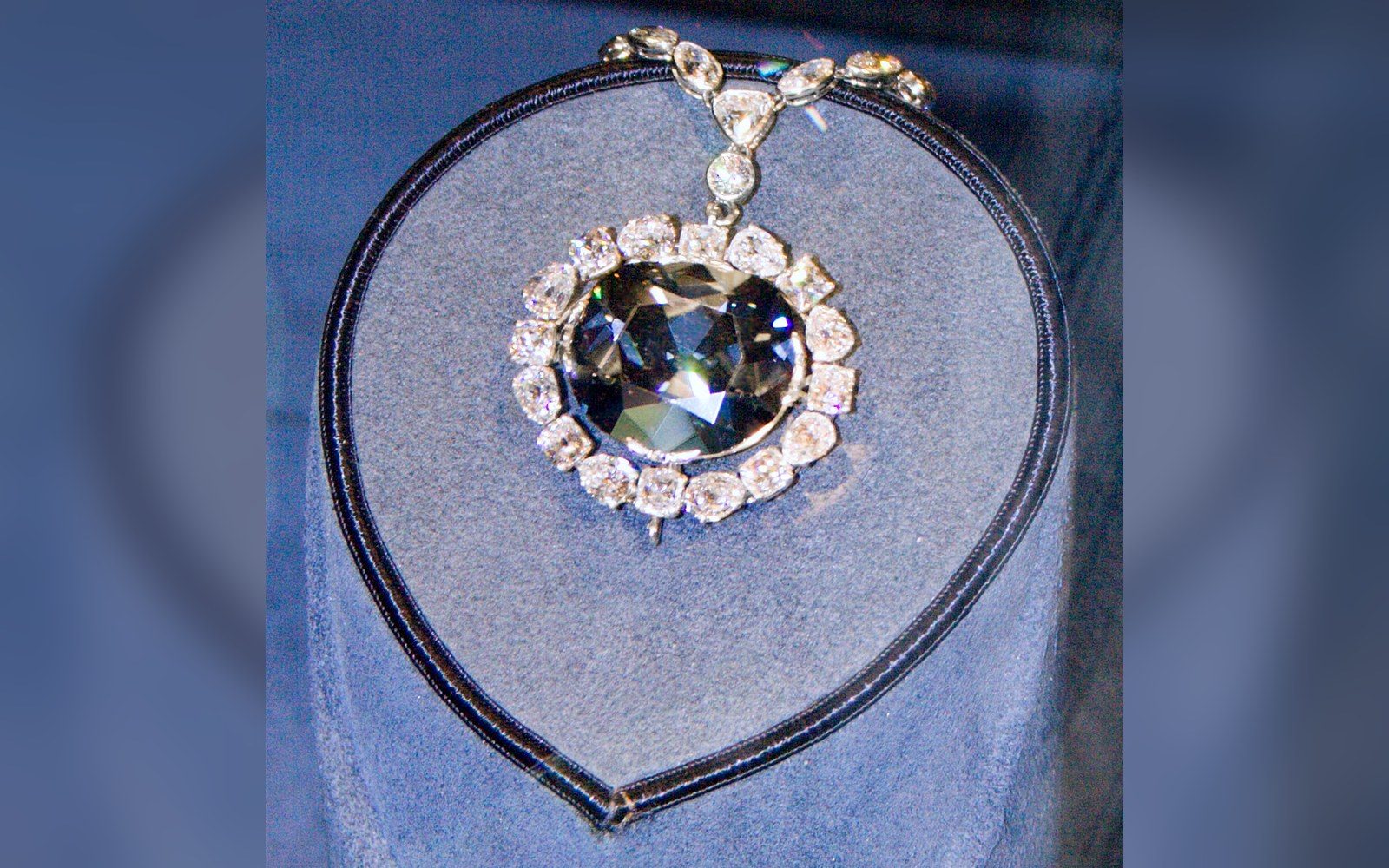
The rotating mount lets the pavilion be seen; the necklace is Cartier's, modified for the museum display.
Photo: Hope Diamond · Wikimedia Commons
What the Record Shows
The Hope Diamond's chain of custody is better documented than that of virtually any other named gemstone, in part because so many of its owners were institutions or notable public figures whose records survived. Gaps remain: the twenty-year period after the 1792 theft and before the 1812 London appearance is unwitnessed, and the intermediate steps between George IV's estate and Henry Philip Hope's catalogue are inferred rather than proven. The Smithsonian makes these gaps explicit in its published documentation rather than papering over them, which is itself a mark of the collection's scholarly standards.
The stone measures 25.60 mm long, 21.78 mm wide, and 12.00 mm deep, in a cushion antique brilliant cut with additional facets on the pavilion. Its type IIb classification — the same category as most naturally blue diamonds — reflects the boron substitution that produces both the colour and the anomalous electrical conductivity that distinguishes IIb stones from the overwhelming majority of diamonds. The Argyle Mine in Western Australia occasionally produced blue diamonds of a different origin (hydrogen-related colour centres rather than boron), a distinction the GIA now records separately; the Hope belongs unambiguously to the boron-coloured category.
After more than sixty-five years in the Smithsonian collection, the Hope Diamond has been examined, measured, and analysed more thoroughly than at any previous point in its documented four-century history — yet it still draws longer queues than almost anything else in the building.
Related