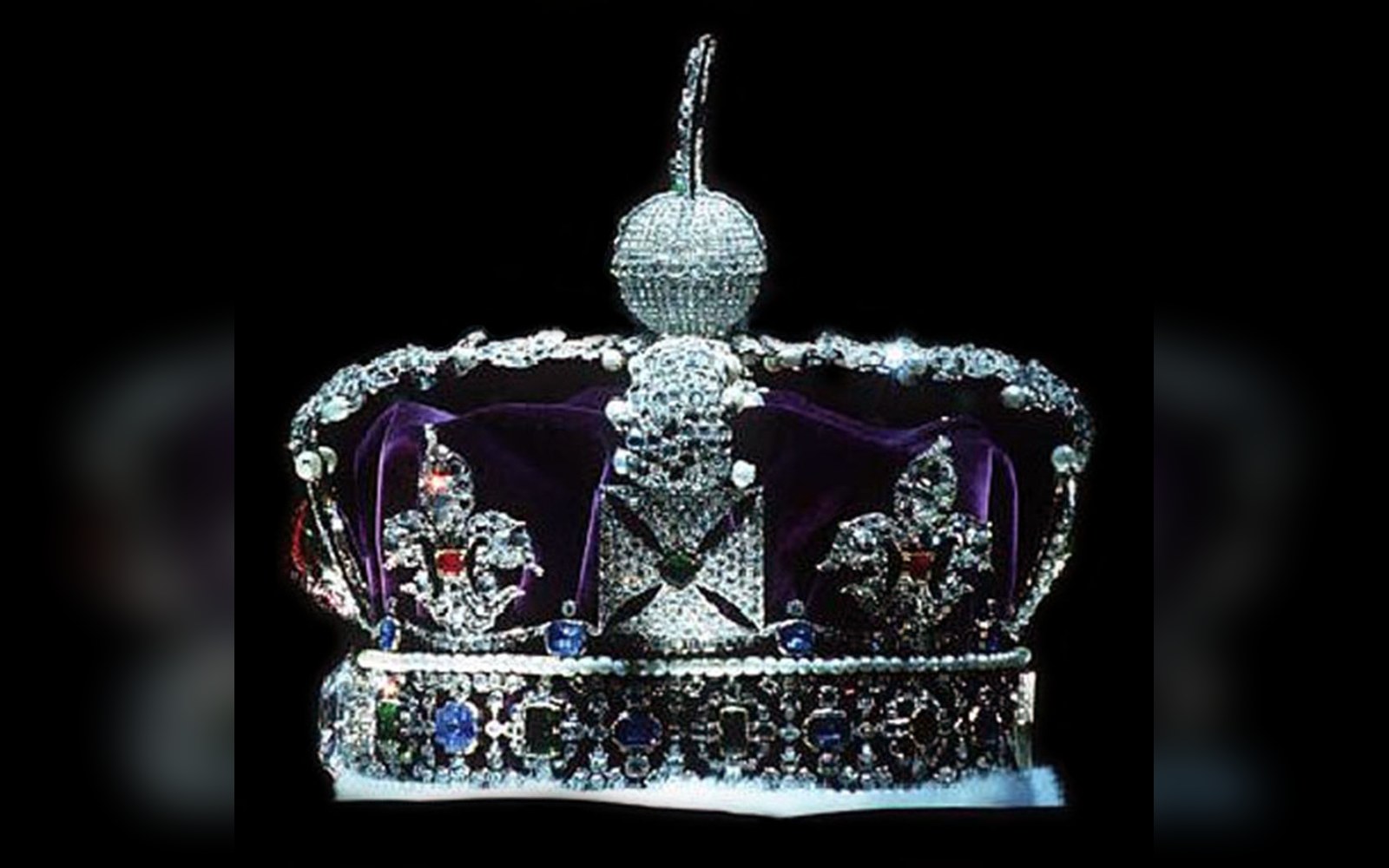
From Moorish Treasury to English Crown
The stone now known as the Black Prince's Ruby entered documented history in the fourteenth century. Medieval Moorish chronicles record it among the treasures of Abu Sa'id, Sultan of Granada, from whose possession it passed — violently, through assassination — to Pedro I of Castile in 1362. Pedro transferred it to Edward of Woodstock, the Prince of Wales known to later historians as the Black Prince, as payment for military assistance at the Battle of Nájera in 1367. From Edward it descended through the English crown jewels, survived Oliver Cromwell's dispersal of the regalia in the 1640s (it was apparently sold and subsequently reacquired), and was set into successive state crowns.
The stone is not faceted in the modern sense. It is a polished, irregularly shaped cabochon approximately 170 carats in estimated weight, roughly 5 centimetres in its longest dimension — figures the Tower of London's catalogue gives as approximate because the stone has never been removed from its current setting for precise measurement. A small drilled hole, a historical perforation probably dating to its time in the Moorish treasury, runs through one end.
Also in Named Stones: The Hope Diamond Came to the Smithsonian by Registered Post
Photo: The Hope Diamond · Wikimedia Commons
What 1783 Changed, and What It Did Not
In 1783 a mineralogist identified the stone as spinel — a magnesium aluminium oxide (MgAl₂O₄) — rather than corundum, the mineral family that constitutes genuine ruby. The distinction matters: spinel and ruby share a deep red colour driven by chromium but belong to entirely different crystal systems. Spinel is cubic; ruby is trigonal. Their refractive indices, specific gravities and crystal structures are unambiguous to a trained gemmologist.
The identification did not change the stone's name or its position in the regalia. When the Imperial State Crown was remade in 1838 for Queen Victoria's coronation, the spinel was placed at the front centre of the crown, directly above the Cullinan II diamond. It remains there. The Gemological Institute of America classifies red spinel from the historically important Central Asian deposits — the very region that supplied the medieval gem trade — as among the finest specimens of the mineral known.
The Black Prince's Ruby is not unique in its misidentification. Centuries of gem trade practice applied the word ruby to any red stone of sufficient transparency, and spinels from Badakhshan were the principal source of large red gems in medieval Europe. That the most famous example still wears the wrong name is less a historical oversight than a measure of how completely a stone's biography can outrun its chemistry.
Related