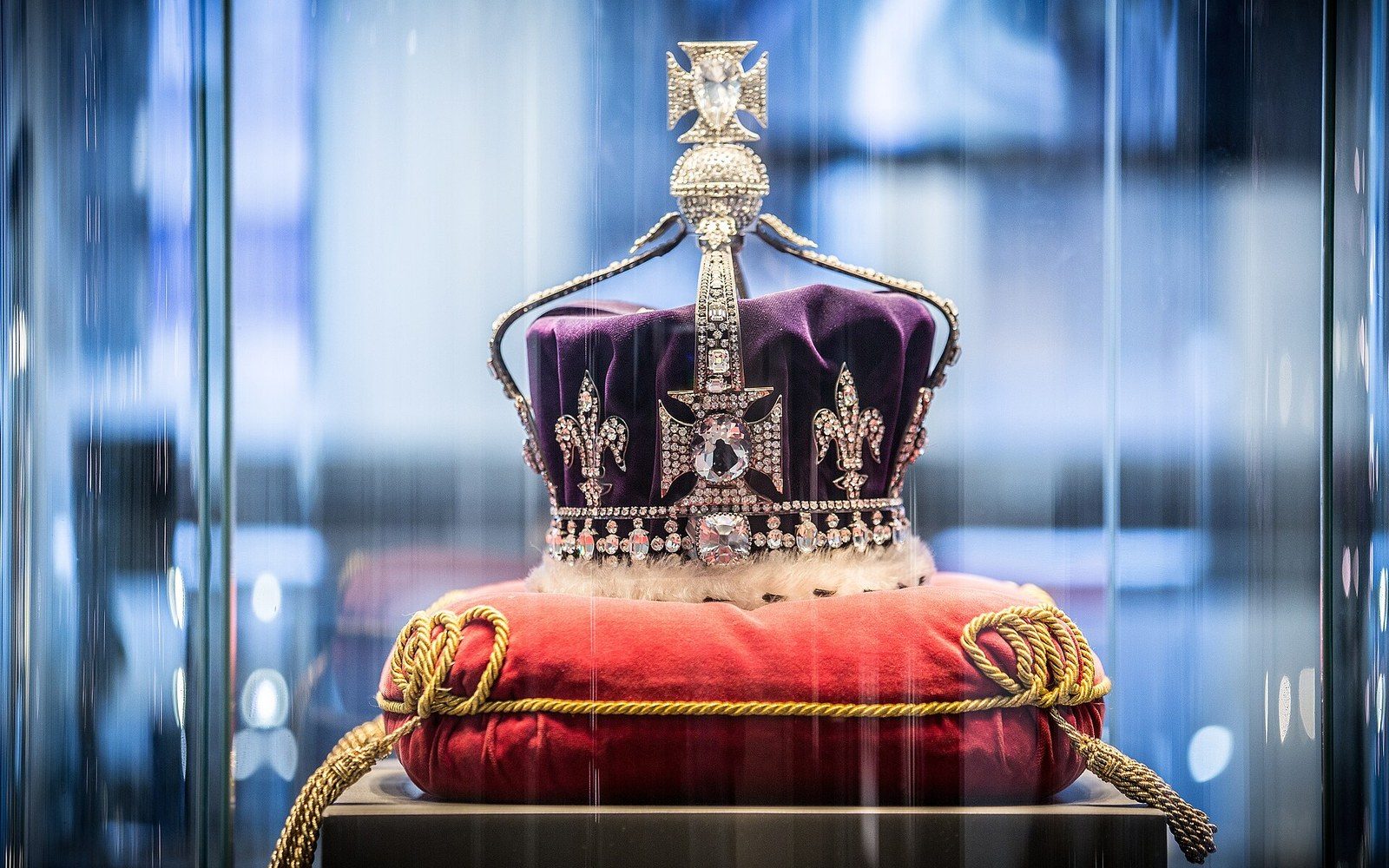
From the Mughal Court to a Glass Case in Hyde Park
The Koh-i-Noor — Persian for "mountain of light" — enters the documented record in Mughal sources from the early seventeenth century, though the stone almost certainly circulated through earlier Deccan courts before that. By the reign of Shah Jahan it was set in the Peacock Throne alongside other exceptional stones, and it remained within the Persian and Afghan imperial orbit after Nader Shah seized it in 1739. The diamond passed through the Sikh court of Lahore under Maharaja Ranjit Singh and, following the annexation of the Punjab in 1849, was formally transferred to the East India Company under the terms of the Last Treaty of Lahore. It reached London in 1850 and was presented to Queen Victoria.
When the diamond went on public display at the Great Exhibition of 1851, the reaction was not admiration. Visitors found it flat, murky, and difficult to see. The problem was largely one of cut: the stone retained the shallow, rounded form characteristic of Indian rose-cut tradition, which had been optimised for candlelight in enclosed court settings, not for daylight inspection inside a glass case at the Crystal Palace in Hyde Park. The organisers tried gas jets, velvet backdrops and angled mirrors, none of which rescued it. Six million people filed past a stone most of them found unimpressive.
Also in Named Stones: The Hope Diamond Came to the Smithsonian by Registered Post
Photo: The Hope Diamond · Wikimedia Commons
The Amsterdam Recutting, 1852
Prince Albert, persuaded that the diamond's reputation required rescue, commissioned a recutting. The work was carried out in 1852 by the Garrard firm, acting as Crown Jeweller, with technical oversight provided by the Amsterdam diamond-cutting house of Coster — the same tradition that had long made Antwerp and Amsterdam the axis of European diamond cutting. Two Dutch specialists, identified in contemporary accounts as Voorzanger and Fedder, operated the cutting wheel; the Duke of Wellington is recorded as having made the first touch of the stone to the wheel, a ceremonial gesture only.
The recutting reduced the diamond from approximately 186 carats in its Indian form to 105.6 carats, as recorded by Historic Royal Palaces at the Tower of London. That is a loss of roughly 43 per cent of the original weight — enormous even by the standards of a period when significant material removal was accepted as the price of a modern brilliant. The finished stone is an oval brilliant, a form reflecting the proportional thinking that would later be formalised by Marcel Tolkowsky, though this recutting predates his 1919 geometric analysis by nearly seven decades.
The reasons for such heavy loss were partly the stone's internal characteristics. The Koh-i-Noor contains a distinct strain crack running through part of its depth, and the cutters had to work around it, sacrificing weight to preserve structural integrity and avoid cleaving the stone. The result satisfied contemporary opinion: the recut diamond was described in press accounts of the time as far more brilliant than its earlier form, though gemologists since have noted that its proportions are not ideal by modern standards.
Setting and Custody
After 1852 the stone was set successively in several pieces of royal regalia. It is now mounted in the front cross of the Crown of Queen Elizabeth The Queen Mother, made in 1937, and held with the Crown Jewels at the Tower of London. It has not left the United Kingdom since its arrival. Competing claims to the diamond have been advanced at various times by the governments of India, Pakistan, Afghanistan and Iran, none of which has resulted in repatriation. The stone's chain of custody — from Mughal treasury to Sikh court to British crown — is among the most thoroughly documented in the history of any named gem, and among the most contested.
Related