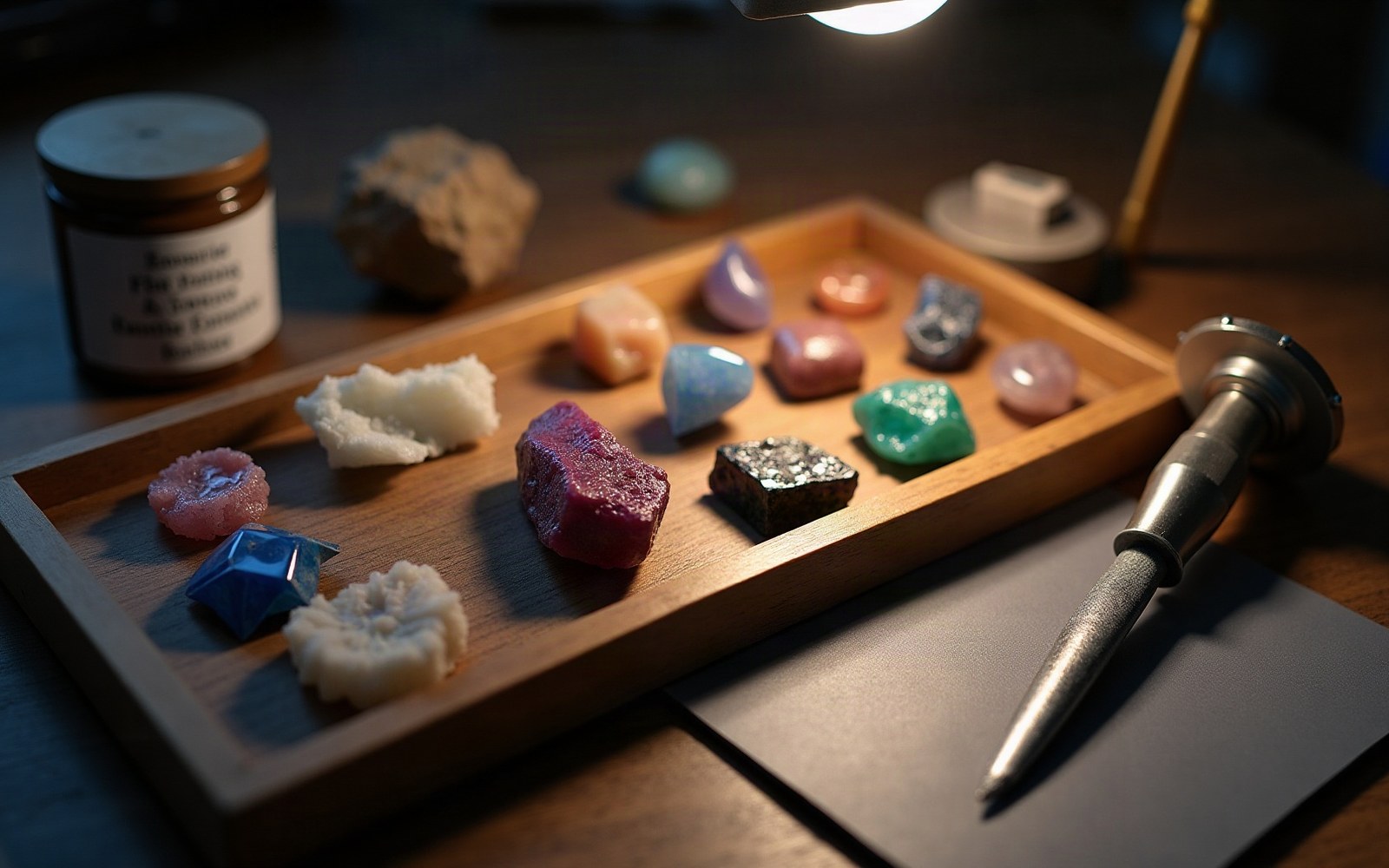
The Scale, Precisely Stated
Friedrich Mohs, a German mineralogist employed at the Graz mineral collection, published his ten-mineral reference series in Versuch einer Elementar-Methode zur naturhistorischen Bestimmung und Erkennung der Fossilien in 1812. The sequence runs from talc (1) through gypsum, calcite, fluorite, apatite, orthoclase feldspar, quartz, topaz and corundum to diamond (10). Each mineral scratches every mineral below it and is scratched by every mineral above it. That is the complete, literal meaning of the scale.
The numbers are ordinal, not arithmetic. The interval between 9 (corundum) and 10 (diamond) is not equivalent to the interval between 1 and 2. Measured in absolute terms — by nanoindentation or Vickers testing — diamond is roughly four times harder than corundum, while the lower steps are compressed into a comparatively narrow band. Mohs was not attempting to quantify absolute hardness; he was building a field-identification tool using minerals a mineralogist could carry in a kit.
Also in Cutting: Three Numbers from 1919 That Nobody Has Managed to Improve On
What It Does Not Measure
Two properties are regularly conflated with Mohs hardness, and neither of them is scratch resistance. The first is toughness — resistance to fracture. Jade (jadeite or nephrite) sits at roughly 6–7 on the Mohs scale but is among the toughest gem materials known, because interlocking crystal microstructures resist crack propagation. Diamond, at 10, cleaves perfectly along octahedral planes and can be split with a single directed blow — precisely the technique Joseph Asscher applied to the Cullinan in 1908.
The second is cleavage resistance. Topaz is Mohs 8, but its perfect basal cleavage means a faceting cutter must orient the stone to avoid laying a polishing direction parallel to that plane, or the surface will tear rather than polish.
A third property, abrasion resistance in service,is different: it is a matter of scratch resistance, and it is the one the scale does address. A mounted gemstone encounters dust, which is predominantly quartz at Mohs 7. Any stone below 7 — including tanzanite (6–7), opal (~5.5–6.5) and moonstone (~6) — will show surface abrasion with daily wear. Mohs hardness predicts that vulnerability accurately, but it does not predict whether the stone will break, chip or split.
How It Actually Gets Used
In the laboratory, GIA gemologists use hardness as one confirmatory datum among several — alongside refractive index, specific gravity and spectroscopic data — never as a standalone identifier. On the cutting wheel, it informs grit selection and polishing-lap choice. It has no role in grading. Mohs himself would have considered both uses appropriate: a practical ordering, applied practically, claiming nothing it cannot deliver.
Related