A Stone, a Hall, and an Open Window
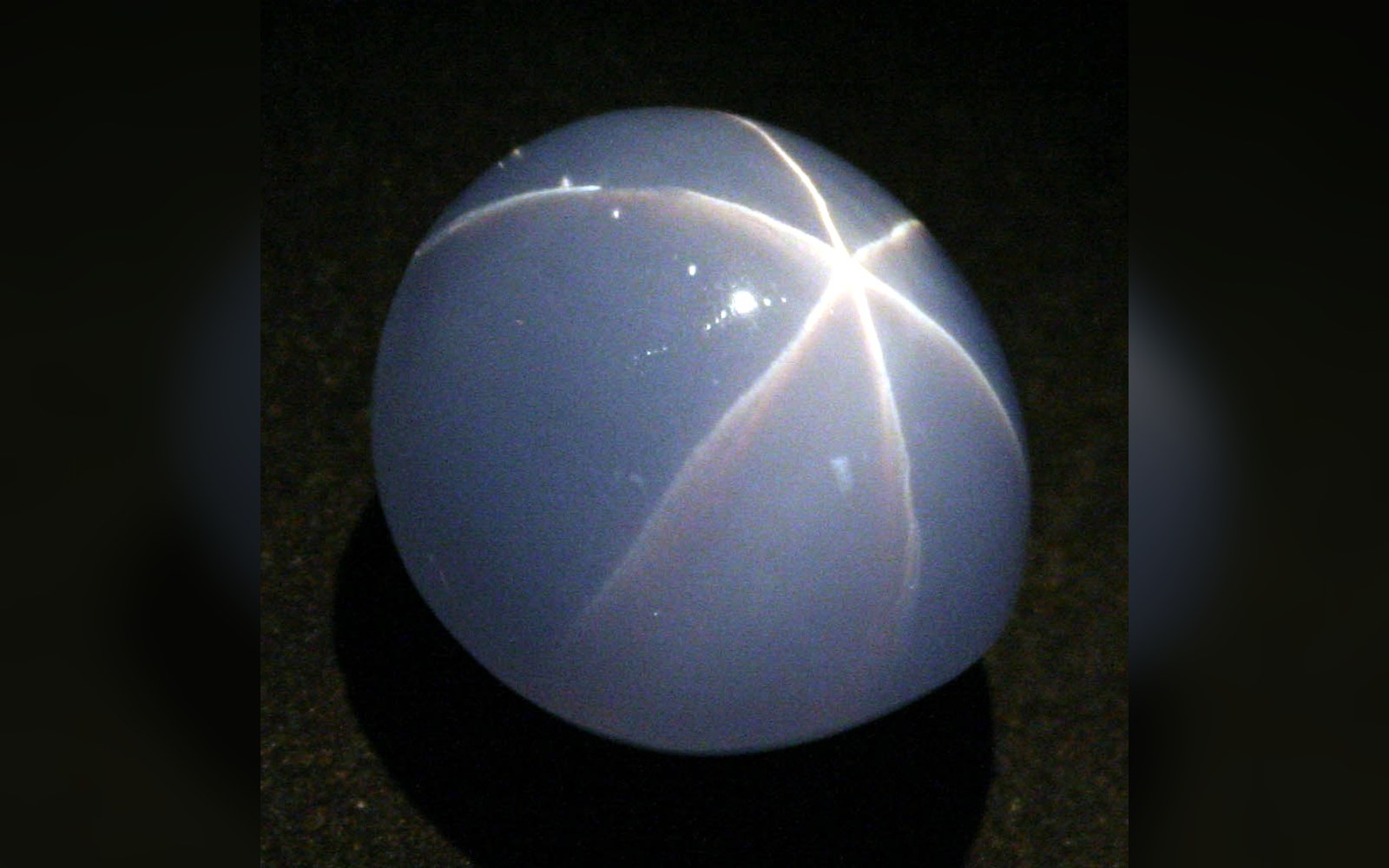
The Star of India is a 563.35-carat cabochon of blue-grey star sapphire held by the American Museum of Natural History in New York. Mined in Sri Lanka — almost certainly from the alluvial illam gravels of the Ratnapura district — it is among the largest gem-quality star sapphires ever documented, and one of very few that displays a strong asterism on both faces. The six-rayed star arises from needle-like rutile inclusions oriented along the crystal axes of the corundum host, a phenomenon the museum has documented and displayed since the stone was donated by financier J. P. Morgan in 1900.
On the night of 29–30 October 1964, three men climbed into the museum's J. P. Morgan Hall of Gems through a window that had been left unlocked. They took twenty-four stones in total, including the Star of India, the DeLong Star Ruby (a 100.32-carat Burmese star ruby, also in the collection), and the Midnight Star, a 116-carat black star sapphire. The operation required no tools beyond what could fit in a knapsack. Museum security, by any subsequent assessment, was not equal to the collection it guarded.
Also in Named Stones: The Hope Diamond Came to the Smithsonian by Registered Post
Photo: The Hope Diamond · Wikimedia Commons
The thieves — Jack Roland Murphy, Allan Kuhn, and Roger Clark — were arrested within days in Miami. Murphy, a beach hustler known in the tabloid press as "Murph the Surf," had made no serious attempt at concealment. Most of the stones were recovered quickly; the DeLong Star Ruby required a ransom of approximately twenty-five thousand dollars, brokered through an intermediary, before it was returned to the museum. The Midnight Star and several smaller pieces came back through police action. The Star of India itself was recovered in January 1965, about two months after the theft, from a locker at a Miami bus station, and suffered no damage.
The theft prompted a comprehensive review of the hall's physical security, including window hardware, case construction, and after-hours monitoring — changes the museum implemented before the hall reopened. The stone returned to its original position, where it has remained on public display ever since.
Mineralogically, the Star of India is unremarkable in composition — corundum, aluminium oxide coloured blue-grey by iron and titanium — but exceptional in size, in the regularity of its star, and in the near-absence of the clouding that degrades asterism in most large specimens. Its cabochon cut, with the dome oriented to centre the star under direct light, is precisely the form that transforms a dense rutile silk into a visible optical phenomenon rather than simple haziness.
Related