The Process and Its Consequences
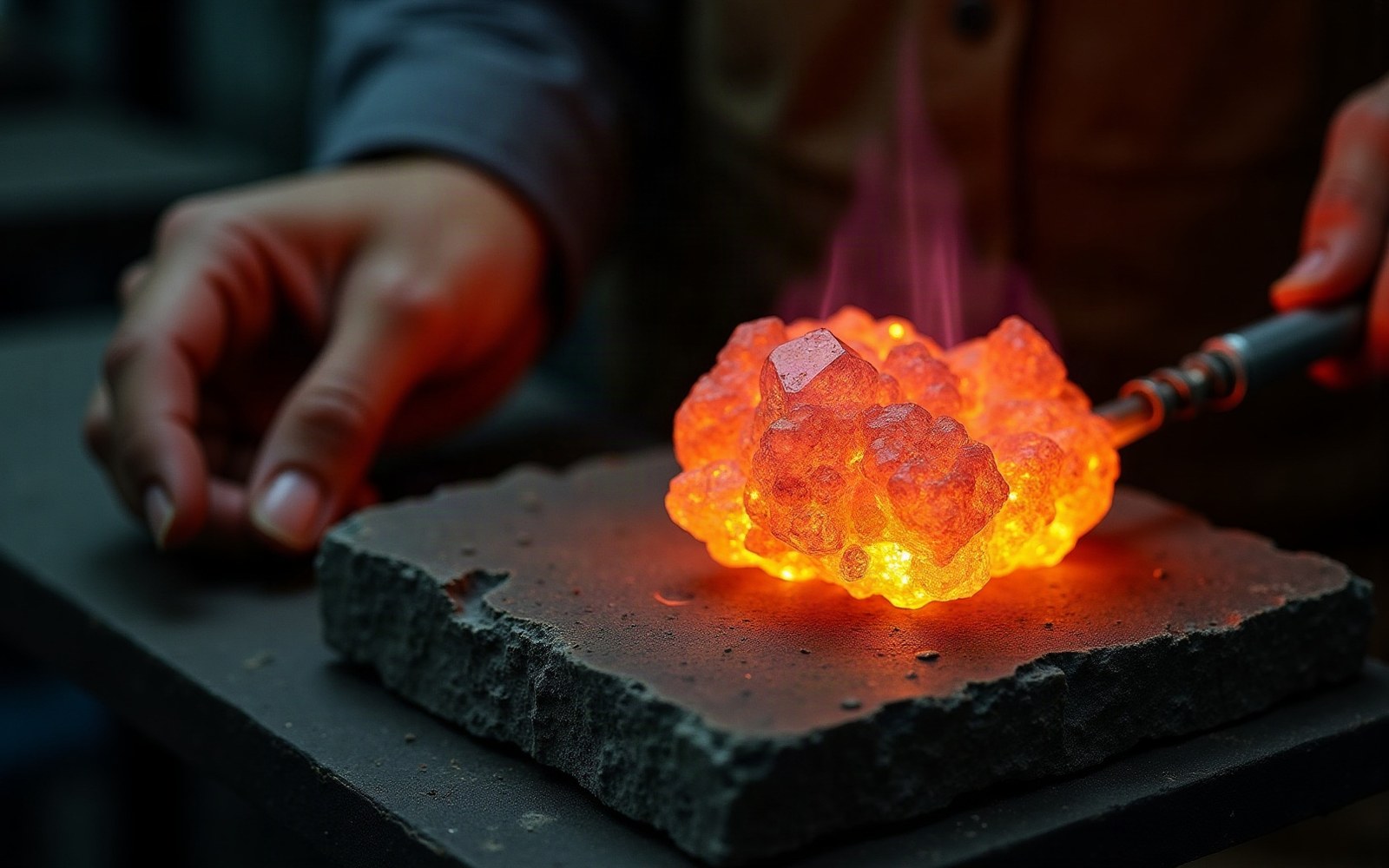
Auguste Verneuil, working at the Muséum national d'Histoire naturelle in Paris, published his flame-fusion method in 1902 after a decade of development. The process was elegant in its directness: finely powdered aluminium oxide, doped with chromium oxide to produce red colour, was fed through a hydrogen-oxygen flame burning at roughly 2,000 °C. The molten droplets settled onto a rotating ceramic support and solidified into a single-crystal ingot — a boule — that, when sliced and faceted, was chemically identical to natural ruby: corundum (Al₂O₃) coloured by chromium.
Verneuil's 1902 paper in the Comptes Rendus de l'Académie des Sciences reported boules large enough to cut commercial stones, and within a few years, Geneva factories were producing Verneuil rubies by the kilogram. The watch industry absorbed enormous quantities: the process yielded hard, uniform, inexpensive corundum for the pivot bearings that precision movements required. By 1910, annual production had reached several million carats.
Also in Diamond: Four Letters the GIA Fixed in 1953
Photo: Plato Terentev / Pexels
The gem trade took longer to adjust. Verneuil material entered markets without disclosure, and its detection required laboratory examination rather than visual inspection. The Gemological Institute of America and European gemmological laboratories eventually standardised the diagnostic: curved growth striations. Natural corundum grows in straight or angular planes following its crystal structure; Verneuil boules grow in concentric arcs around the flame axis, producing curved striae visible under magnification in polarised light. Gas bubbles — spherical rather than the irregular two-phase inclusions typical of natural stones — further confirm synthetic origin. These remain the primary identification markers recognised by gemmological laboratories today.
Verneuil's method was also adapted for sapphire, producing blue stones from iron- and titanium-doped alumina, and later for spinel, rutile and other materials. The process never entirely displaced natural stones in prestige jewellery — origin, rarity and the documented provenance of a Mogok ruby or a Ratnapura sapphire carry weight that no boule can replicate — but it permanently restructured the industrial corundum market and forced the trade to develop rigorous separation protocols that remain central to gemological practice.
The flame-fusion process continues in production. Modern Verneuil material is distinguished from later synthetic methods — notably flux-grown and hydrothermal synthetic corundum — by the same curved striations and bubble populations that laboratories documented a century ago.
Related