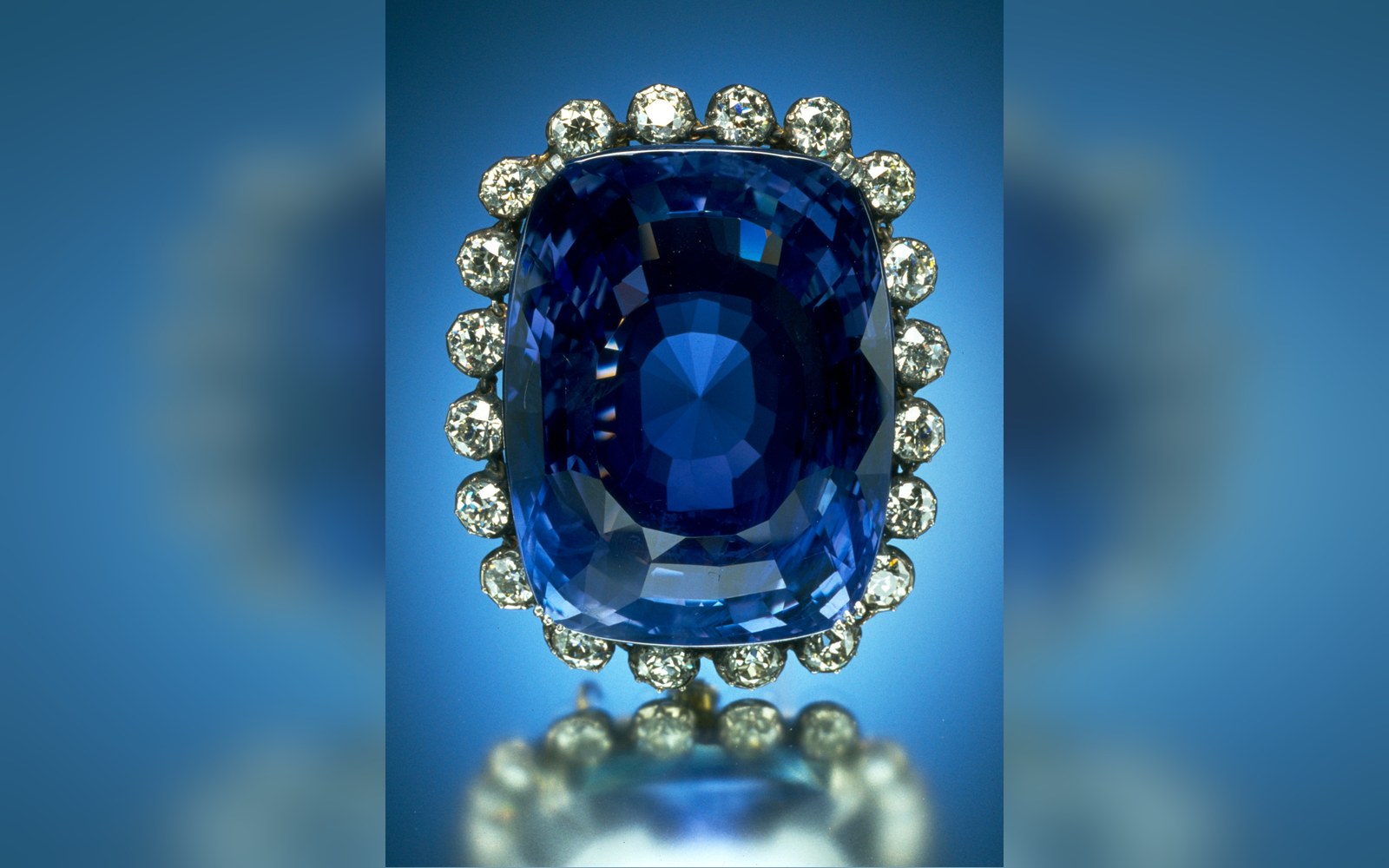
A Stone in Three Dimensions
The Logan Sapphire measures roughly 4.5 centimetres at its longest dimension, which is, as the Smithsonian's own catalogue notes, approximately the size of a hen's egg. It is cushion-cut, cornflower to medium-dark blue, and mounted in a platinum brooch bordered by twenty round diamonds. The colour derives from iron and titanium substituting for aluminium in the corundum crystal lattice — the same chemistry that distinguishes every sapphire from the rubies that share its mineral species.
Rebecca Pollard Logan donated the stone to the Smithsonian Institution in 1960, and it passed into the National Gem Collection at the National Museum of Natural History in Washington, D.C., where it remains on public display. The Logan Sapphire is frequently cited alongside the Star of Bombay and the Star of Asia as one of the defining pieces of that collection.
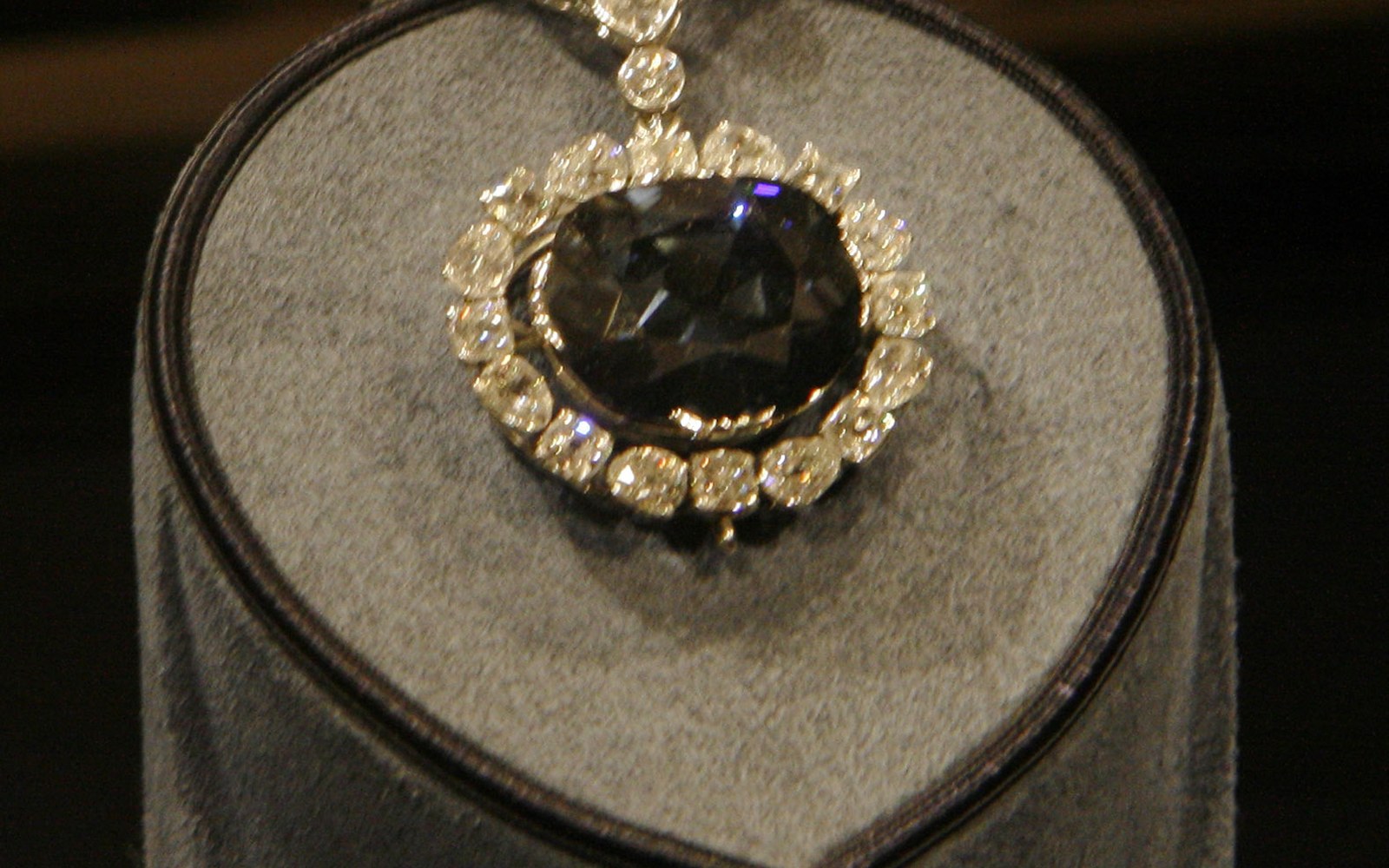
Also in Named Stones: The Hope Diamond Came to the Smithsonian by Registered Post
Photo: The Hope Diamond · Wikimedia Commons
What Ratnapura Produces
Sri Lanka origin is the consensus attribution for the Logan Sapphire, and the most probable source is the alluvial gravel deposits of the Ratnapura district in Sabaragamuwa Province — the country's principal gem-bearing region for millennia. Ratnapura's gems do not come from primary rock. They weather out of pegmatites and metamorphic host material in the surrounding hills, then concentrate in ancient river-bed gravels called illam, where miners recover them by sluicing and hand-sorting.
Sri Lankan sapphires form in a geological environment unusually low in iron relative to many competing sources, which tends to produce stones of exceptional transparency and moderate-to-strong blue saturation rather than the inky darkness associated with some Australian material. A stone reaching 422.99 carats in the rough — large enough to yield a faceted gem of that weight — would represent a crystal of extraordinary size and clarity, consistent with the coarse-grained metamorphic conditions that the Ratnapura basin is documented to favour.
The Logan Sapphire has no recorded cutting history attached to a named lapidary or workshop, which places it among the significant proportion of historic large stones whose pre-donation biography is incompletely documented. What the Smithsonian catalogue confirms is the carat weight, the cut, the donor and the date — and in the record of notable gems, that is more attribution than many stones ever receive.
Related